
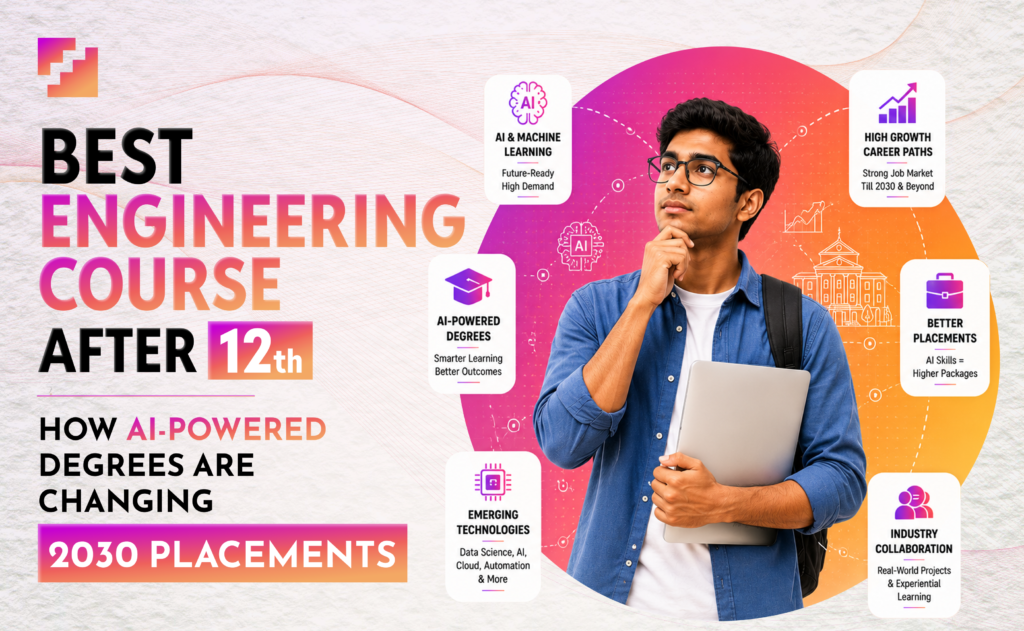
Picture a Class 12 student, board exam papers barely submitted, sitting across from a parent already comparing colleges on five browser tabs. The question feels simple: what’s the best engineering course after 12th? It used to be; pick Computer Science for logic, Mechanical for machines, Civil for stability. That formula worked for decades. It doesn’t anymore, and the reason isn’t the colleges. It’s what’s waiting on the other side of the degree, in a job market already moving faster than the advice at that kitchen table today.
The Conversation Happening at Every Dinner Table This Year
Walk into any home with a Class 12 student right now, and you’ll hear some version of the same debate. An uncle insists Mechanical is “evergreen.” A cousin who graduated three years ago says everyone should just do Computer Science. A neighbour swears by Electronics because “hardware never goes out of style.” Nobody at that table is wrong, exactly.
They’re all answering a question from a different decade.
The honest answer to what makes the best engineering course after 12th in 2030 isn’t a single branch name anymore. It’s whether the course, regardless of branch has built AI literacy into its core, not bolted it on as an elective nobody attends.
Choosing a course is step one. Knowing what it actually costs and returns is step two, Check-out this article for a better POV: Engineering Admission 2026: The ROI Calculation Every Parent Must Do Before Choosing a College
Why AI Changed the Question Itself?
Here’s something that should genuinely surprise you: the skills that got engineering graduates hired in 2015 are not the same skills getting graduates hired in 2026, and by 2030, the gap will be wider still. Companies aren’t just looking for someone who can write code anymore. They’re looking for someone who can work alongside AI tools, understand what those tools are doing under the hood, and know when to trust the output and when to question it.
A graduate who treats AI as a mysterious black box is starting their career already behind someone who treats it as a daily working tool.
This is exactly why Gen AI courses have moved from “nice to have” electives to something closer to a survival skill. Whether a student studies Mechanical, Civil, or Computer Science, the question recruiters are quietly asking in 2030 is the same: did this degree teach you to work with AI, or did it just teach you to avoid it?
What “Best” Actually Means Now…?
If you ask ten different people which engineering course is best for future careers, you’ll get ten different branch names. That’s the wrong way to frame the question. The right way to frame it is this: does the program treat AI as infrastructure, the same way it treats mathematics or physics, something woven into every year, every project, every assessment or does it treat AI as a single optional module tucked into the syllabus to check a box? A program that treats AI seriously doesn’t need to announce it loudly. It shows up in the projects students build, the tools they’re comfortable touching, and the confidence they walk into an interview with.
| What to Look For | Outdated Engineering Course | AI-Powered Engineering Course |
| AI exposure | One elective, often in final year | Integrated across all four years |
| Project work | Theoretical, exam-focused | Built using real AI engineering course tools and frameworks |
| Faculty background | Academic only | Mix of academic and AI-industry practitioners |
| Certifications | Separate cost, separate effort | Best AI courses bundled into the curriculum |
| Placement readiness | Catch-up training after graduation | Built in from day one |
| 2030 hiring outcome | Competing on degree name alone | Competing on demonstrable AI fluency |
Best Engineering Courses After 12th for the AI Era
Knowing what to look for in a course is one thing. Knowing which actual courses are built this way is another. Here are five engineering paths leading the shift, along with where they can realistically take a graduate.
1. Computer Science Engineering (CSE) with AI & Machine Learning
This is one of the most sought-after engineering courses today, and for good reason, it sits at the intersection of traditional software skills and the AI capabilities companies are actively hiring for. Students learn artificial intelligence, machine learning, deep learning, Python programming, cloud computing, natural language processing, and computer vision.
Scope: Graduates can step into roles as AI engineers, software developers, data scientists, or machine learning engineers. This branch offers the widest range of entry points into the tech industry, since nearly every sector from finance to healthcare to e-commerce, now needs people who can build and maintain AI-powered systems.
Students learn:
Artificial Intelligence
Machine Learning
Deep Learning
Python Programming
Cloud Computing
Natural Language Processing
Computer Vision
2. Artificial Intelligence and Data Science
This specialized degree focuses entirely on intelligent systems and data-driven decision-making, rather than treating AI as one subject among many. Students develop expertise in big data analytics, statistical modeling, predictive analytics, neural networks, AI algorithms, and data visualization.
Scope: The demand for data professionals continues to rise across industries, and this degree is built specifically for that demand. Career paths include data analyst, AI research associate, business intelligence specialist, and data science consultant roles that are increasingly difficult to fill, which works in favour of well-trained graduates.
Students develop expertise in:
Big Data Analytics
Statistical Modeling
Predictive Analytics
Neural Networks
AI Algorithms
Data Visualization
3. Robotics and Automation Engineering
Industries are rapidly adopting robots for manufacturing, healthcare, logistics, and space exploration, making this one of the more future-facing branches available. Students learn embedded systems, robotics programming, sensor technologies, automation, industrial AI, and control systems.
Scope: Graduates work in robotics companies, manufacturing industries, and research organizations. As factories and warehouses continue automating, and as healthcare robotics expands, this branch offers strong long-term relevance, particularly for students who enjoy working at the intersection of hardware and intelligent software.
STUDENTS LEARN:
Embedded Systems
Robotics Programming
Sensor Technologies
Industrial AI
Control Systems
4. Cybersecurity Engineering
As cyber threats increase in both frequency and sophistication, cybersecurity professionals are becoming indispensable rather than optional. Modern cybersecurity programs include ethical hacking, digital forensics, AI-based threat detection, network security, cloud security, and incident response.
Scope: Companies worldwide are investing heavily in cybersecurity talent, and that investment shows no sign of slowing down. Career paths include security analyst, penetration tester, cybersecurity consultant, and AI-security specialist, a newer role specifically focused on defending AI systems themselves from manipulation and attack.
MODERN CYBERSECURITY PROGRAMS INCLUDE:
Ethical Hacking
Digital Forensics
AI-based Threat Detection
Network Security
Cloud Security
Incident Response
5. Electronics and Communication Engineering with AI
ECE remains relevant by integrating AI into communication systems, embedded devices, autonomous vehicles, and IoT applications — proving that even a traditional branch can stay future-ready when AI gets woven into its core. Students gain knowledge in embedded AI, IoT development, wireless networks, signal processing, and intelligent electronics.
Scope: Graduates find opportunities in telecommunications, automotive technology (particularly autonomous vehicles), smart device manufacturing, and IoT infrastructure companies. This path suits students who want the tangibility of hardware combined with the growing relevance of AI-driven intelligent systems.
STUDENTS GAIN KNOWLEDGE IN:
Embedded AI
IoT Development
Wireless Networks
Signal Processing
Intelligent Electronics
Across all five, the common thread is the same one this article keeps returning to: the branch name matters less than how deeply AI is built into the four years of learning that happen before graduation.
The Story of Two Students, Same Year, Same Rank
Here’s a story worth sitting with, because some version of it is happening right now in colleges across the country.
Two students enter engineering with nearly identical entrance ranks. One enrolls in a traditional course that treats programming as the only skill that matters and leaves AI for “later.” The other enrolls in a course where Gen AI courses, machine learning fundamentals, and applied AI engineering course modules are part of the curriculum from year one, not an afterthought. Four years later, the first student graduates with strong fundamentals but has to spend the next six to eight months catching up, learning AI tools on their own time, often paying out of pocket for certifications, while watching classmates from the second path walk straight into interviews with portfolios full of AI-integrated projects.
This isn’t a hypothetical gap. It’s the gap defining placement outcomes right now, and it will only widen by 2030.
Five Questions Every Student Should Ask Before Choosing!
Before deciding on the best engineering course after 12th, sit down with these five questions out loud, with whoever is helping make this decision.
Does this course teach AI as a foundation, or as an afterthought? If AI shows up once in four years as a single elective, that’s a red flag, not a feature.
Will I graduate having actually built something with AI, or just heard about it in a lecture? Hands-on project work matters far more than theoretical exposure.
Are the best AI courses part of the fee, or something I’ll need to pay for separately after graduation? Hidden post-graduation costs add up fast, and they delay your first paycheck too.
Does the faculty include people who’ve actually worked with AI in industry, or only academics teaching from textbooks? Real-world exposure changes how a subject gets taught.
If I imagine my first job interview in 2030, will this course have prepared me to answer questions about AI tools confidently, or will I be learning that on the job, under pressure, for the first time? Your honest answer to this one question often reveals everything else.
Choosing With Eyes Open, Not Just Hope
There’s no shame in not knowing the right branch at 17 or 18. Nobody does, really not with certainty. What matters more than picking the “perfect” branch is picking a course structure that doesn’t leave you behind the moment you walk out with the degree in hand. The best engineering course after 12th in 2030 won’t be remembered for its branch name. It will be remembered for whether it prepared a student to work confidently in a world where AI isn’t a buzzword anymore, it’s just how work gets done. Ask the five questions. Compare the courses honestly, and choose the path that builds the skills your future job will actually expect, not the one that simply sounds familiar to the people giving advice at the dinner table.
Explore official course and admission details for engineering programs at aicte-india.org
Author
