
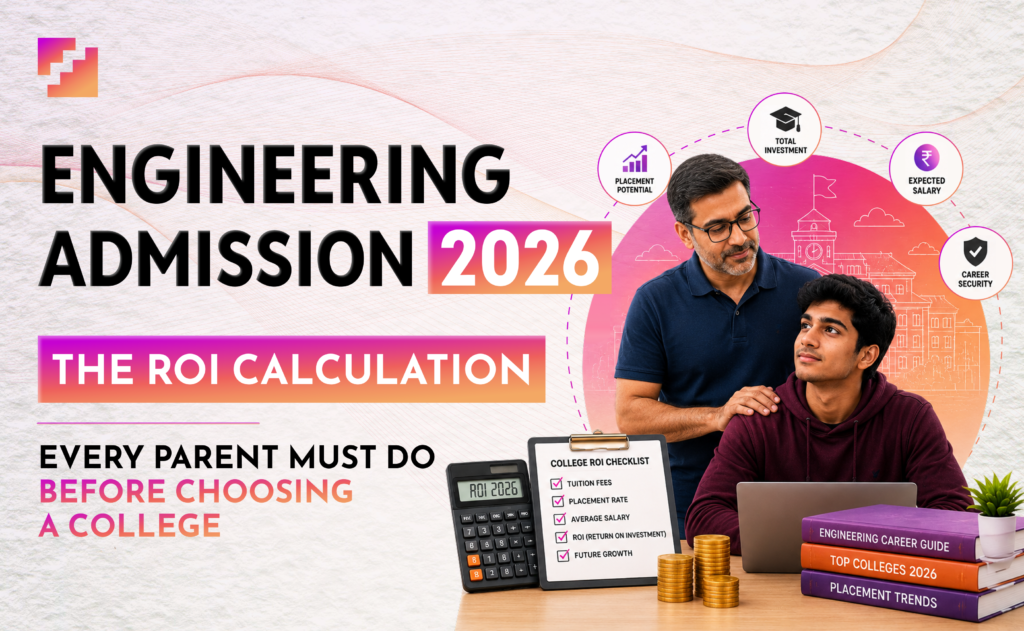
Has anyone in your family ever sat down and actually added it all up? Every fee, every term, every year; from the very first day of Pre-KG to the very last day of Class 12. Most parents haven’t. The bills arrive separately, spread across years. Nobody ever gathers them into a single number. A school fee here, a tuition fee there, books and uniforms tucked in between. Each payment feels manageable on its own. But engineering admission 2026 is exactly the moment that total finally needs to be confronted. Because right now, a much bigger figure is about to join everything that already came before it. This isn’t a conversation most families have out loud. It happens quietly, almost accidentally, usually late at night after a counselling form has been filled and submitted. And it’s a conversation worth having before that form gets submitted, not after.
The Question That Comes Before The College Admission
Here’s the question every family needs to ask before engineering admission 2026 gets locked in: what does this entire investment, made one fee at a time over more than a decade, actually return? A student finishes four years of engineering and walks into their first interview. What does the company check first? Not the degree. Not the college name printed on it. What they actually ask is something else entirely. Does this candidate have industry-ready skills? Have they built real-world projects? Do they carry internship experience? Have they worked inside a team, with real exposure to how teams actually function? Can they demonstrate genuine problem-solving ability? A large number of students cannot answer “yes” to these five questions with real confidence and that single gap is where this entire story begins.
Before you calculate the ROI, check the numbers; engineering admission 2026 has the highest enrollment ever recorded: Engineering Admission 2026 Hits All-Time High Enrollment
What Happens After the Degree Is Already Finished?
Here’s what tends to happen next, and it happens to far more students than most families realize. Once the degree is done, many students discover they still aren’t employable in the way they expected. So they start again separately, on their own; enrolling in coding courses, industry certifications, aptitude training, communication classes, and placement coaching, one after another. This is the part nobody plans for at the start. Becoming employable, after the degree is already finished, ends up costing an extra ₹1 lakh to ₹2.5 lakh, money that was never part of the original engineering admission 2026 budget conversation. There’s a simple way to describe this: it’s the actual hidden cost of engineering. Not the fee on the brochure. The fee that shows up afterward, quietly, once the first one has already been paid.
The Part That Costs More Than Money
Here’s the part of this story that rarely gets discussed at the kitchen table, but matters just as much as the money. It isn’t only about rupees. Confidence starts to wear thin. Friends begin comparing job offers, and the comparison stings more each time. A quiet fear of the “job gap” sets in. And in many cases, an entire career gets delayed by six months to a full year, time that, once lost, doesn’t come back.
The root problem, stated as simply as possible: a wrong engineering choice equals financial risk plus career risk, both arriving together, neither one separate from the other.
Two Engineering Paths, One Honest Comparison
Here’s a direct, side-by-side comparison between a traditional engineering degree and an industry-integrated engineering degree, based on what each path typically costs and returns over four years. The traditional route looks cheaper on the surface, a lower number on the very first fee receipt. But once the post-graduation training costs get added in, the real total often lands close to, or even past, the industry-integrated option, without the same head start in the job market.

| Category | Traditional Degree | Industry-Integrated Degree |
| Average Tuition Fee (4 Years) | ₹3,50,000 | ₹6,00,000 |
| Coding & Skill Courses (Post-Graduation) | ₹40,000 – ₹80,000 | Included |
| Certifications | ₹15,000 – ₹40,000 | Included |
| Aptitude & Interview Training | ₹15,000 – ₹35,000 | Included |
| Internship Support | Self-arranged, often unpaid | Structured, often stipend-based |
| Hidden Post-Graduation Cost | ₹70,000 – ₹1,50,000 | ₹0 |
| Estimated Real Total Investment | ₹4,20,000 – ₹6,05,000+ | ₹6,00,000 |
| Average Starting Salary | ₹18,000 – ₹30,000 / Month | ₹35,000 – ₹90,000 / Month |
| Average Salary After 3 Years | ₹40,000 – ₹80,000 / Month | ₹1,00,000+ / Month |
| Time to Become Job-Ready After Graduation | 6–12 Months Extra Training | Job-Ready at Graduation |
| Overall Career Risk | Higher — Skill Gap Can Delay Employment | Lower — Skills Built Alongside Degree |
Figures are indicative averages based on general industry patterns and may vary by institution, region, and individual performance.
Ask This Before You Ask “Which College”
Before heading into counselling, before even asking “which college,” ask a different question first: “which career path.” Here’s why that order matters. An engineering seat is not success. A degree is not success either, not on its own. Building a future-ready, high-growth career on top of that degree is the only outcome that actually counts as success.
That single shift in the question from “which college” to “which career path” changes how the entire engineering admission 2026 decision gets made.
The Real Answer Behind the ROI Question
Run the full calculation honestly, and the answer becomes clear. The degree is just the starting point. What happens around it, the skills built, the projects completed, the internships secured, the readiness developed before graduation rather than after it, is what actually determines the return on every rupee spent since Pre-KG. That is the real ROI calculation every parent needs to do this engineering admission 2026 season, before the counselling window closes and the decision is already made.
Check official engineering admission 2026 updates and registration details at tneaonline.org
Author
