
On July 9, 2026, OpenAI released two things simultaneously, a new model and a new question. The model is GPT-5.6, described as the most capable AI system OpenAI has ever built. The question; the one engineering students, fresh graduates, and their parents are now asking louder than ever is whether AI will replace humans at work. The honest answer is more nuanced than either side of the debate usually admits. GPT-5.6 and ChatGPT Work don’t prove that AI will replace humans. They do prove that the nature of human work is changing faster than most people expected. For engineering students preparing to enter the job market in the next two to four years, understanding what actually changed on July 9 and what didn’t is the most important career intelligence available right now.
What GPT-5.6 and ChatGPT Work Actually Are?
GPT-5.6 is OpenAI’s latest frontier model, released in three versions; Sol (most powerful), Terra (optimised for speed), and Luna (balanced performance and cost). According to OpenAI, GPT-5.6 is 54% more token-efficient on agentic coding than its predecessor, reduces hallucinations by 40%, and introduces a 2-million-token context window. More significantly, GPT-5.6 introduces what OpenAI calls “ultra mode”; a multi-agent setup where subagents work in parallel to accelerate complex tasks. In practical terms, this means GPT-5.6 can now break a large project into multiple parallel workstreams, run them simultaneously, and synthesise the results; the kind of coordination that previously required a team of people.
ChatGPT Work is the platform built on top of GPT-5.6 and this is the product with the more immediate implications for working professionals. ChatGPT Work can integrate directly into enterprise systems; Slack, Microsoft Teams, Google Drive, SharePoint, email, calendars, CRM platforms, and project management tools. It can gather information from connected apps, create spreadsheets, presentations, documents and web apps, and continue working for hours by breaking larger projects into smaller steps.
More than 5 million people already use Codex, OpenAI’s coding agent; every week. Notably, more than 1 million of those users are outside software development. ChatGPT Work is the next step; bringing the same agentic capability to sales, finance, marketing, legal, and every other knowledge work function.
What This Actually Does to Jobs? The Honest Picture
The question “will AI replace humans” gets asked as though the answer is binary, either AI takes all the jobs or it takes none. The reality is more specific and more immediate than that.
AI is not replacing humans. AI is replacing tasks.
Here is the distinction that matters: GPT-5.6 and ChatGPT Work are exceptionally good at tasks that are routine, repeatable, well-defined, and high-volume. They are significantly less capable at tasks that require judgment under genuine uncertainty, creative synthesis from incomplete information, or human relationship management.
| Tasks AI Does Well | Tasks Humans Still Do Better |
| Code generation from specifications | Deciding what to build and why |
| Report generation from structured data | Interpreting ambiguous signals from clients |
| Summarising large documents | Building trust with stakeholders |
| Automating repetitive workflows | Navigating organisational politics |
| Debugging known error patterns | Diagnosing novel system failures |
| Generating marketing copy at scale | Developing original brand strategy |
The jobs at highest risk are not the most technical ones; they are the ones that consist almost entirely of well-defined, repeatable tasks. A junior analyst who spends 80% of their time generating standard reports is more at risk than a senior engineer who spends 80% of their time making architectural decisions.
AI vs Human Intelligence: Where the Real Difference Lies?
The framing of “AI vs human intelligence” misses something important. AI and human intelligence are not the same type of intelligence competing for the same space. They are different types of capability and the most valuable professionals in the AI era will be those who understand how to use one to amplify the other.
What AI has that humans don’t:
- Speed at scale, GPT-5.6 can process and synthesise information orders of magnitude faster than any human
- Consistency; it never gets tired, distracted, or emotionally reactive
- Breadth, it can operate across domains simultaneously without context-switching costs
- Parallelism; with multi-agent setups, it can run dozens of workstreams at once
What humans have that AI doesn’t:
- Genuine understanding of consequences, AI optimises for specified objectives; humans understand what happens when the wrong objective gets specified
- Embodied judgment; the ability to read a room, feel the stakes of a decision, and act on intuition built from real experience
- Accountability, humans can be held responsible in ways that AI cannot
- Novel problem framing, AI is exceptional at solving well-framed problems; humans are better at recognising which problems need to be solved at all
The engineers who will thrive in the AI era are not those who compete with AI on its own terms; raw processing speed and data synthesis but those who understand AI well enough to direct it, evaluate its outputs, and design the systems within which it operates.
What GPT-5.6 Means Specifically for Engineering Students?
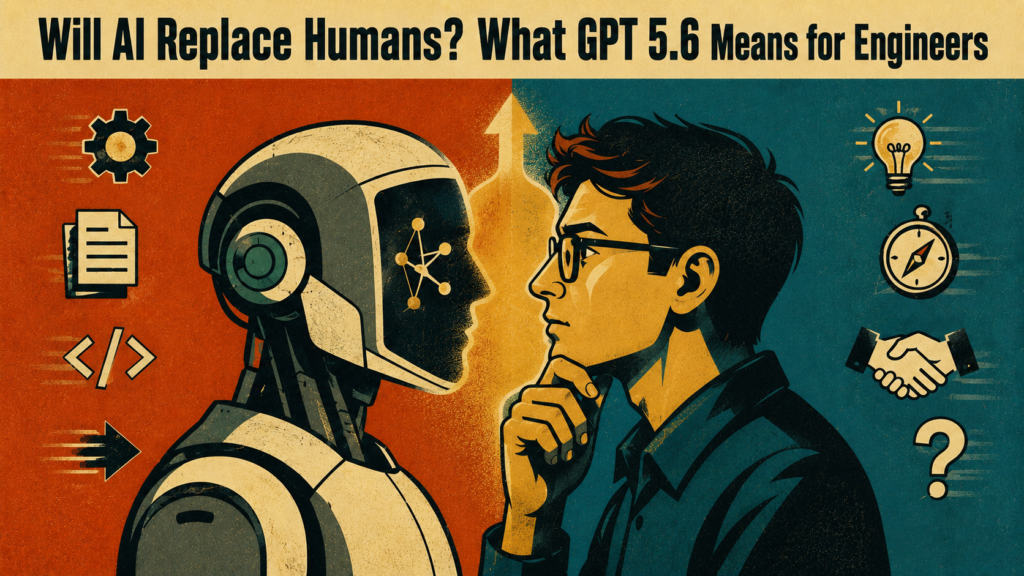
For students currently in engineering programs or about to enter the workforce in 2026–2030, GPT-5.6 and ChatGPT Work change the landscape in four specific ways:
1. The baseline for junior roles is rising.
When GPT-5.6 can generate production-quality code from a specification, the value of a junior engineer who can “write code” decreases. The value of a junior engineer who can write good specifications, review AI-generated code critically, identify edge cases the AI missed, and take ownership of the output; increases significantly.
Engineering students need to develop the skills that sit above and around code generation, not just code generation itself.
2. Domain knowledge becomes more valuable, not less.
As AI handles more of the execution layer, the scarcity shifts to people who understand the domain well enough to know whether the AI’s output is actually correct. In healthcare technology, a software engineer who understands clinical workflows will consistently outperform one who doesn’t, because they can catch errors the AI makes that a pure coder would miss.
3. AI/ML engineers are in higher demand than ever.
The deployment of systems like GPT-5.6 and ChatGPT Work creates enormous demand for engineers who can build, fine-tune, evaluate, and maintain AI systems. The AI ML engineer salary in India is already one of the highest in the technology sector and as agentic AI systems become more complex, the demand for engineers who understand them at a deep level will only grow.
According to industry data, AI and ML engineers in India earn between ₹8–25 LPA at the entry to mid level, with senior roles and specialised skills pushing significantly higher. These figures are expected to grow as the deployment of systems like GPT-5.6 expands across Indian enterprises.
4. The AI era rewards T-shaped engineers.
The most valued engineers in the AI era are T-shaped; broad enough to understand what AI can and cannot do across domains, deep enough to be genuinely expert in at least one area. An engineer who is excellent at systems design, genuinely understands machine learning fundamentals, and can communicate technical decisions to non-technical stakeholders is significantly more valuable than one who specialises only in writing code.
Will AI Replace Jobs? The Sector-by-Sector Reality
Rather than a blanket answer, here is the honest picture by sector most relevant to engineering graduates:
| Sector | AI Impact | What Changes | What Stays Human |
| Software Development | High | Code generation, testing, documentation | Architecture, product decisions, client relationships |
| Data Science | High | Report generation, standard analysis | Novel hypothesis generation, strategic interpretation |
| Mechanical Engineering | Moderate | Design iterations, simulation analysis | Physical testing, manufacturing judgment, client specs |
| Civil/Structural Engineering | Moderate | Structural calculations, compliance checking | Site judgment, safety decisions, regulatory navigation |
| AI/ML Engineering | Low (paradoxically) | Routine model training tasks | System design, evaluation, novel architecture |
| Embedded Systems | Low | Code generation for known patterns | Hardware-software integration, novel system design |
The sectors most protected from AI displacement are those with high physical complexity, high regulatory accountability, or high interpersonal judgment requirements. Engineering disciplines that combine technical depth with these factors are the most resilient career choices for the next decade.
The Career Advice Most Engineering Students Need Right Now
Don’t panic. Adapt.
The students who will be most affected by GPT-5.6 and ChatGPT Work are those who are preparing to do the same tasks in the same way that humans have always done them; without developing the judgment, domain expertise, and AI fluency that makes a human genuinely irreplaceable. The students who will benefit most are those who treat tools like GPT-5.6 as a force multiplier, using AI to do in hours what used to take days, and spending the freed time developing the higher-order skills that AI cannot replicate.
The most valuable engineering skill in 2026 is not writing code. It is knowing what code to write, why to write it, and whether what was written actually solves the right problem.
That judgment is still human. It will remain human for longer than most of the current panic suggests. And for engineering students who develop it deliberately; this era of AI is an opportunity, not a threat.
AI won’t replace you. But knowing which tools to use will set you apart. Start here: Best AI Tools for Students 2026: What Meta’s New Muse Image Generator Means for Engineering and AI Learners
Read OpenAI’s official GPT-5.6 announcement at openai.com
Author
