
Every few months, a new AI tool lands that engineering and AI students need to pay attention to, not just because it’s trending, but because it changes what’s possible in the field they’re preparing to work in. Meta’s Muse Image is one of those tools. Launched on July 8, 2026 by Meta Superintelligence Labs, Meta’s dedicated AI research division, Muse Image is now available free across the Meta AI app, Instagram Stories, and WhatsApp. Within hours of launch, it became one of the most discussed AI tools of the year, not just for what it can do, but for what it does without asking permission. For engineering and AI students, Muse Image is worth understanding on two levels: as a technical product that demonstrates what modern generative AI can achieve, and as a case study in the privacy and ethics debates that every AI engineer will navigate in their career.
What Is Meta Muse Image? A Quick Overview
Muse Image is Meta’s first fully in-house AI image generation model, built by Meta Superintelligence Labs. Until now, Meta had relied on third-party image generation models from Midjourney and Black Forest Labs. Muse Image marks the company’s first fully in-house alternative.
What it can do:
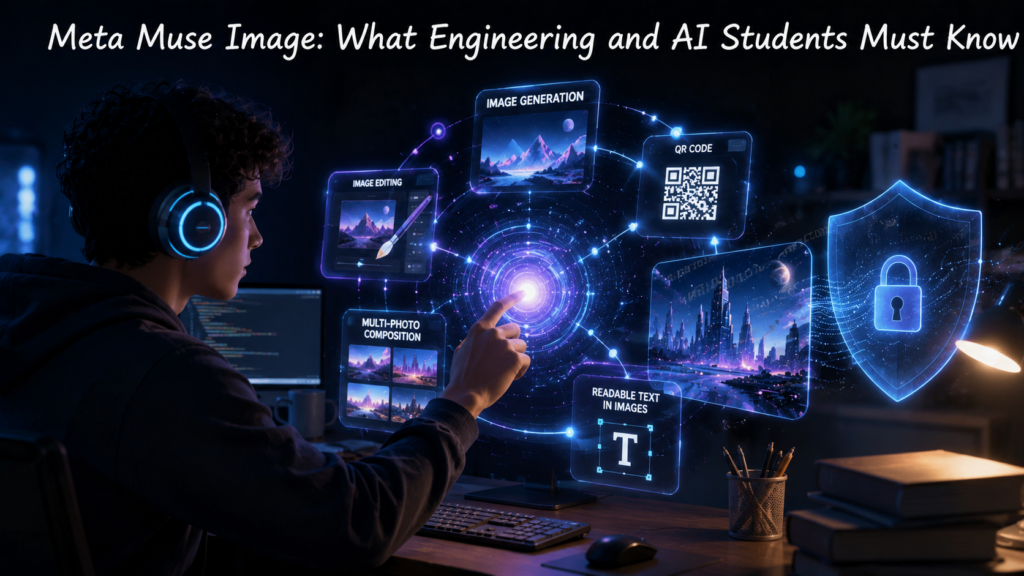
- Text-to-image generation: Create images from text prompts from photorealistic scenes to cartoonish illustrations
- Image editing: Modify existing photos using text instructions; remove backgrounds, change elements, create new scenes without regenerating the entire image
- Multi-photo composition: Combine multiple photos into a single AI-generated image
- QR code generation: Generate readable, branded QR codes; a task that has historically been difficult for image models
- Readable text in images: Render readable text within generated images, another historically challenging capability
- Instagram Stories effects: 30+ new AI-powered effects for Instagram Stories
- Preset prompts: Pre-built image prompts to “spark ideas” for users who don’t know where to start
Availability: Free for standard use; Meta AI app, Instagram Stories, WhatsApp. A paid Meta One subscription applies once usage limits are exceeded.
Architecture: Unlike conventional text-to-image systems, Muse Image uses an agent-based architecture that reasons through requests before generating, searches the web for current information, and refines its own outputs iteratively.
The Privacy Controversy: What Every AI Student Must Understand?
The feature that triggered immediate backlash is this: Muse Image allows any user to tag a public Instagram profile and use that person’s publicly available photos to generate new AI images of them, without notifying the person whose photos are being used. Meta’s policy states directly: “People may be able to create content with your Instagram content using AI features at Meta” and “you will not be notified about content created using AI features at Meta.”
The reaction was swift. One user described it as “a privacy landmine waiting to detonate.” Creative Artists Agency (CAA), one of Hollywood’s largest talent agencies; formally called on Meta to make protection the default rather than opt-out, stating: “True Innovation Puts Creators First.”
Meta’s response: “We built Muse Image with strong controls and safety guardrails from day one.” The company also noted that every Muse Image output carries an invisible Content Seal watermark that survives cropping, resizing, and compression; a technical measure intended to identify AI-generated content.
The technical safeguards Meta has implemented:
- Invisible Content Seal watermark on all generated images
- Policy guardrails preventing generation of violating content
- Opt-out settings for users who don’t want their public images used
The gap critics identify:
- Opt-out, not opt-in; the default is permissive, not protective
- No notification to the person whose photos are used
- Public profile = implicit consent in Meta’s current framework, a definition many users dispute
Why This Matters for Engineering and AI Students?
1. It’s a Live Case Study in AI Ethics
Every AI engineering curriculum now includes AI ethics, responsible AI development, and data privacy. Muse Image’s launch is not a textbook scenario; it’s a real, live example of the tensions that exist between technical capability, commercial deployment, and user consent.
The questions Muse Image raises are exactly the questions future AI engineers will face in their careers:
- When does “publicly available” data become “ethically usable” data?
- Who is responsible for harm caused by AI-generated content?
- Should protection be opt-in or opt-out by default and who decides?
- How do watermarking and provenance tracking change the accountability landscape?
These aren’t philosophy questions. They’re engineering product decisions and the students studying AI and CSE today will be making these decisions in 5 years.
2. It Demonstrates the Current State of Generative AI
From a technical standpoint, Muse Image is a meaningful benchmark in the generative AI landscape. According to Meta’s internal benchmarks, Muse Image outperforms Google’s Nano Banana 2 on image-editing tasks, though it trails OpenAI’s GPT Image 2 on overall image quality. These comparisons are based on Meta’s own testing and haven’t been independently verified.
The architectural choice; agent-based reasoning before generation, web search integration, iterative self-refinement, represents the direction the entire image generation field is moving. Understanding this architecture is directly relevant to AI and ML students studying large multimodal models.
3. It Shows Where the Industry Is Going
Meta is not stopping at images. Muse Video, a companion AI video generation model built on the same architecture; is already in development, with broader availability expected in the coming months. The integration of Muse Image into Meta’s Advantage+ advertising platform is also planned, enabling AI-generated marketing assets at scale.
For students preparing for careers in AI, this trajectory matters: image → video → advertising → eventually every visual creative output. The engineers building these systems, evaluating their safety, and designing their consent frameworks are the people today’s AI and CSE students will become.
Best AI Tools for Students in 2026: Where Muse Image Fits?
Muse Image is one entry in a rapidly expanding toolkit of AI tools students are using in 2026. Here’s how it fits alongside the tools most relevant to engineering and AI learners:
| Tool | What It Does | Best For Students |
| Meta Muse Image | AI image generation and editing | Prototyping UI/UX concepts, understanding multimodal AI |
| GitHub Copilot | AI code completion and generation | Coding productivity, learning new languages |
| Google Gemini | Multimodal AI assistant | Research, summarisation, code explanation |
| ChatGPT (OpenAI) | Text, code, image generation | Writing, problem-solving, concept explanation |
| Perplexity AI | AI-powered research and search | Academic research, source-cited answers |
| Cursor | AI-powered code editor | Full-stack development, debugging |
| Midjourney | High-quality AI image generation | Design projects, portfolio work |
| Claude (Anthropic) | Long-context AI assistant | Document analysis, complex reasoning tasks |
For engineering students specifically, the most immediately useful AI tools remain coding-focused; GitHub Copilot, Cursor, and Gemini for code explanation. Muse Image’s value for engineering students is more in understanding what it represents technically than in using it daily.
Will AI Replace Software Engineers? The Real Answer in 2026
The honest answer in 2026 is no; not the role, but increasingly the tasks. Tools like Muse Image, GitHub Copilot, and GPT-4o are automating significant portions of routine creative and coding work. However, the engineers who understand how these tools work, why they make the decisions they make, and what their failure modes look like are more valuable than ever; not less.
The Muse Image privacy controversy is a perfect illustration of why. The tool works brilliantly. The product decision to default to opt-out rather than opt-in is where the human judgment failed. Fixing that requires not just better code; it requires engineers who understand consent frameworks, ethics guidelines, and the social consequences of default settings.
AI replaces tasks. Engineers who understand AI become irreplaceable.
What Engineering Students Should Actually Do With This Information?
1. Use Muse Image as a learning tool, not just a creative one.
If you’re studying AI or ML, explore how Muse Image’s agent-based architecture differs from earlier diffusion models. The architectural reasoning it uses is a meaningful advance worth understanding.
2. Study the privacy debate as an engineering case study.
The CAA response, Meta’s policy statement, and the opt-out framework are all engineering product decisions with social consequences. This is what responsible AI development looks like in the real world.
3. Practice prompting.
How to generate AI images effectively; with specific, structured prompts is a skill that transfers across every image generation tool. Practice on Muse Image’s free tier while it’s new and the preset library is expanding.
4. Stay current on AI tool developments.
The AI tool landscape in 2026 is moving faster than any single course can track. Building the habit of following product launches, reading technical documentation, and understanding new architectures is the most valuable long-term investment an engineering student can make.
The Bottom Line on Meta Muse Image for Engineering and AI Students
Meta Muse Image is technically impressive, freely available, and genuinely useful for specific tasks. The privacy controversy around it is also real and worth understanding not as a reason to avoid the tool, but as a window into the product decisions that define responsible AI development. As an engineering student, your job isn’t just to use AI tools. It’s to understand them well enough to build better ones; with the consent frameworks, transparency mechanisms, and ethical defaults that tools like Muse Image are still figuring out. That’s what makes this generation of AI students different from every generation that came before. You’re not just learning to use the tools. You’re preparing to design the next version of them.
Muse Image is Meta’s entry. Google has its own set of AI tools worth knowing. Here are the top 5 for students: Top 5 Google AI Tools for Students: Study Smarter in 2026
Explore Meta Muse Image at ai.meta.com
Author
