
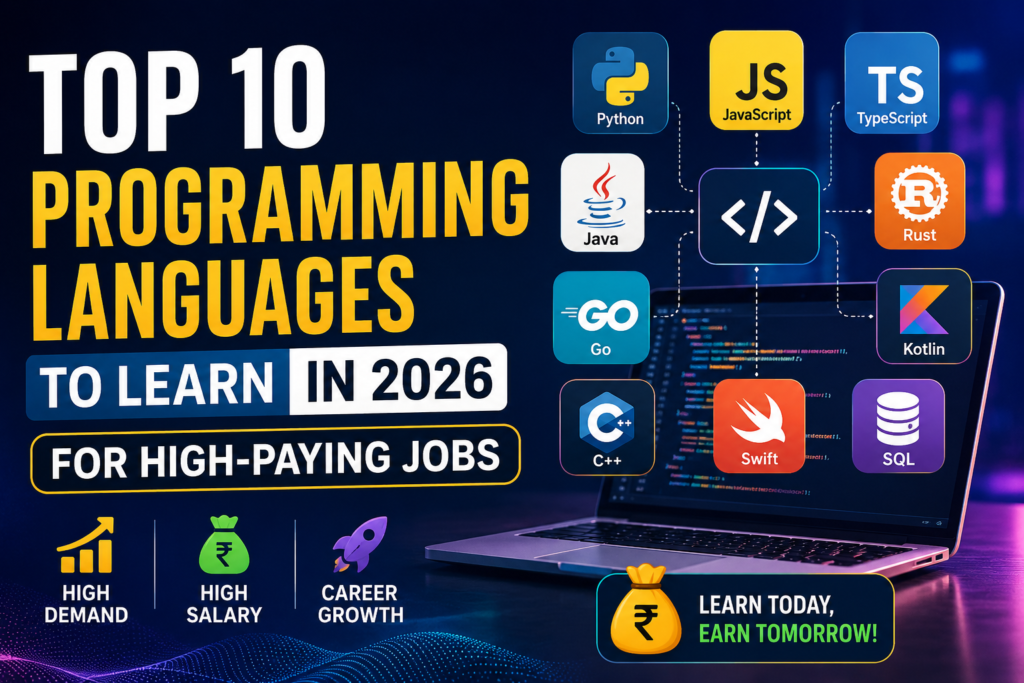
Top 10 Programming Languages can shape your career, salary, and job opportunities in 2026. This guide compares the most in-demand programming languages based on hiring trends, salaries, learning difficulty, and real-world applications to help you choose the right one.
The gap between top-paid and average software developers has widened significantly in recent years, driven by growing demand for specialised skills in AI, cloud computing, fintech, and enterprise software development.
Python ranks number one for 2026 job opportunities, driven by AI and ML demand where 80 percent of engineers use it. Meanwhile, Rust commands the highest senior salaries globally. Furthermore, specialised languages like Rust, Go, and Scala tend to pay the highest average salaries because fewer developers know them well relative to demand.
Table of Contents
-> Top 10 programming languages to learn in 2026
-> Quick comparison table
-> How to choose the right programming language in 2026
-> FAQs
Top 10 programming languages to learn in 2026
Each language below is ranked based on job demand, salary data, growth trajectory, and relevance to the current 2026 hiring market. Consequently, a language that pays extremely well but has limited job openings ranks lower than one with strong salaries and abundant demand.
Beginner-friendly, high-demand languages
01. Python
AI, Data Science, Automation, Web
Avg salary (India)
Rs 8 to Rs 22 LPA
Job demand
Highest in 2026
Difficulty
Beginner friendly
Python remains the most in-demand programming language in 2026, driven by strong growth in AI, machine learning, data science, and automation. Furthermore, AI job postings have grown 134 percent from 2020, and 80 percent of ML engineers use Python as their primary tool. As a result, Python gives you the widest range of high-paying career paths of any language on this list — from data science to backend development to AI engineering.
Machine learning | Data science | Django and Flask | Automation | AI engineering
02. JavaScript
Web Development, Full Stack, Frontend
Avg salary (India)
Rs 6 to Rs 18 LPA
Job demand
Number 1 in web
Difficulty
Beginner friendly
JavaScript is the number one most used language globally, with 69 percent of professionals relying on it and 98 to 100 percent of websites depending on it. Moreover, it is the only language that runs natively inside browsers, which means every web product you see uses it on the frontend. Notably, frontend and full-stack developers who pair JavaScript with React or Node.js command significantly higher salaries than those using it alone.
React and Next.js | Node.js | Full-stack development | Frontend engineering | Mobile with React Native
TypeScript and its place in the 2026 job market
03. TypeScript
Web, Full Stack, Enterprise Frontend
Avg salary (India)
Rs 10 to Rs 25 LPA
Job demand
GitHub number 1, 2025
Difficulty
Easy after JavaScript
TypeScript ranked number one on GitHub Octoverse 2025 and commands a 10 to 15 percent salary premium over JavaScript. Additionally, 78 percent of JavaScript job postings now require TypeScript knowledge. Therefore, learning TypeScript after JavaScript is not optional in 2026 — it is an immediate salary upgrade that takes only 2 to 4 weeks to pick up.
Angular | Node.js | Enterprise frontend | Node.js backend | Type-safe APIs
Enterprise and high-salary specialist languages
04. Java
Enterprise, Backend, Android, Banking
Avg salary (India)
Rs 6 to Rs 20 LPA
Job demand
90% of Fortune 500
Difficulty
Moderate
Java continues to power the backends of most Fortune 500 companies and shows 13 percent job growth with a 7.8 percent salary increase in recent data. Specifically, banking, healthcare, and large IT service companies run almost entirely on Java. Consequently, it remains the safest, most stable choice for students targeting TCS, Infosys, Wipro, and similar enterprise-focused employers in 2026.
Spring Boot | Microservices | Enterprise backend | Android development | Banking systems
05. Rust
Systems Programming, Cybersecurity, Infrastructure
Avg salary (India)
Rs 18 to Rs 40 LPA
Job demand
$130k to $235k
Difficulty
Advanced
Rust sits at the top of every salary ranking in 2026, commanding average compensation above $155,000 annually for experienced engineers globally. What makes it unique is that it delivers the raw performance of C and C++ while eliminating the memory safety vulnerabilities that make those languages dangerous in production. However, Rust is not a beginner language. It rewards engineers who already understand systems programming and are ready to invest 6 to 12 months learning it properly.
Systems programming | Cybersecurity | WebAssembly | Embedded systems | Cloud infrastructure
06. Go (Golang)
Cloud, Backend, DevOps, Microservices
Avg salary (India)
Rs 15 to Rs 35 LPA
Job demand
Cloud and DevOps
Difficulty
Moderate
Go is among the most in-demand programming languages for cloud computing and AI-driven applications in 2026. Notably, Docker and Kubernetes — the two tools that power modern cloud infrastructure — are both written in Go. As a result, backend engineers and DevOps professionals who learn Go gain direct access to cloud-native roles at companies like Google, Netflix, and Uber, which consistently pay among the highest in the industry.
Docker and Kubernetes | Cloud-native backend | Microservices | DevOps tooling | API development
Mobile, systems, and emerging languages
07. Kotlin
Android, Backend with Spring, Cross-Platform
Avg salary (India)
Rs 10 to Rs 28 LPA
Job demand
Android development
Difficulty
Moderate
Kotlin has replaced Java as Google’s preferred language for Android development, and it continues to attract strong salaries driven by fintech, healthtech, and enterprise mobile demand. Furthermore, Kotlin Multiplatform now lets developers share business logic across Android, iOS, and web from a single codebase. Consequently, Kotlin skills are increasingly valuable beyond pure Android roles, opening backend opportunities through Spring Boot as well.
Android development | Kotlin Multiplatform | Spring Boot backend | Fintech apps | Healthtech
C++, Swift and SQL for high-performance roles
08. C++
Game Development, Competitive Programming, Systems
Avg salary (India)
Rs 8 to Rs 25 LPA
Job demand
High-performance systems
Difficulty
Advanced
C++ remains indispensable for high-performance systems, game development engines like Unreal Engine, and competitive programming at top product companies. Additionally, for engineering students preparing for placements, C++ is arguably the best DSA language since its STL library provides efficient, ready-to-use implementations of every standard data structure. Moreover, the language’s demand in high-frequency trading, embedded systems, and operating system development keeps its salary ceiling among the highest for experienced engineers.
Game development | Competitive programming | Embedded systems | High-frequency trading | Operating systems
Emerging languages worth knowing in 2026
09. Swift
iOS, macOS, Apple Ecosystem
Avg salary (India)
Rs 10 to Rs 30 LPA
Job demand
iOS development
Difficulty
Moderate
Swift is the only language for building native iOS and macOS applications, which gives it a captive demand that general-purpose languages simply cannot replicate. Specifically, the next wave of mobile innovation — AI-integrated apps — is pushing even more companies to invest in native iOS development rather than cross-platform alternatives. Furthermore, Apple’s growing ecosystem across Vision Pro, Apple Watch, and Apple Silicon creates consistent new Swift opportunities that did not exist even two years ago.
iOS development | macOS apps | SwiftUI | Apple Vision Pro | AI-integrated mobile apps
10. SQL
Data Engineering, Backend, Analytics, BI
Avg salary (India)
Rs 6 to Rs 18 LPA
Job demand
Data roles at any level
Difficulty
Beginner friendly
SQL appears in job descriptions for data engineers, data analysts, backend developers, product managers, and business intelligence roles alike — making it the most universally required skill on this list. Additionally, SQL appears in the coding benchmark of multiple placement drives including Cognizant GenC and Capgemini Exceller. Consequently, learning SQL is one of the highest-return investments any engineering student can make, regardless of which primary language they choose.
Data engineering | Business intelligence | Backend development | Data analytics | PostgreSQL and MySQL
Quick comparison table
Before choosing from the Top 10 Programming Languages to Learn in 2026, compare the languages side by side to identify the best fit for your career goals.
| Language | Best for | Salary range (India) | Difficulty |
|---|---|---|---|
| Python | AI, Data Science, Automation | Rs 8 to Rs 22 LPA | Beginner |
| JavaScript | Web, Full Stack, Frontend | Rs 6 to Rs 18 LPA | Beginner |
| TypeScript | Enterprise Web, Full Stack | Rs 10 to Rs 25 LPA | Easy after JS |
| Java | Enterprise, Banking, Android | Rs 6 to Rs 20 LPA | Moderate |
| Rust | Systems, Security, Infrastructure | Rs 18 to Rs 40 LPA | Advanced |
| Go | Cloud, DevOps, Backend | Rs 15 to Rs 35 LPA | Moderate |
| Kotlin | Android, Spring Boot | Rs 10 to Rs 28 LPA | Moderate |
| C++ | Games, Competitive, Systems | Rs 8 to Rs 25 LPA | Advanced |
| Swift | iOS, macOS | Rs 10 to Rs 30 LPA | Moderate |
| SQL | Data, Backend, Analytics | Rs 6 to Rs 18 LPA | Beginner |
Related Reads
-> Capgemini Exceller Hiring 2026: Eligibility, Test Pattern and Interview Process
-> Wipro Elite NTH 2026: Eligibility, Exam Pattern, Syllabus & Interview Process
How to Choose from the Top 10 Programming Languages
The best programming language is not the one that pays the most in isolation. Instead, it is the one that aligns with your current skill level, your target job domain, and the companies you realistically want to join. Therefore, use these two filters before you decide.
Choose by your career goal
- AI and data science: Python first, then add SQL and a deep learning framework like TensorFlow or PyTorch
- Web and full-stack development: JavaScript first, then TypeScript as an immediate follow-up since it appears in 78 percent of JS job postings
- Android development: Kotlin, since Google has made it the official preferred language over Java
- Cloud and DevOps engineering: Go, with Docker and Kubernetes as the practical applications to learn alongside it
- High-paying specialist roles: Rust, but only after you have 1 to 2 years of experience in another language first
- Campus placements at service companies: Python or Java, since both appear across TCS, Infosys, Wipro, and Cognizant coding rounds
Choose by your available timeline
If you have 3 to 6 months before placements, pick Python or Java and go deep rather than sampling multiple languages. Depth beats breadth at every stage of the evaluation process. If you have 12 or more months available, build your primary language well and then add one complementary skill. Specifically, Python plus SQL, or JavaScript plus TypeScript, are the two most valuable combinations for most engineering students in 2026. Ultimately, a GitHub profile with three to five deployed projects in any of these languages is worth more to a recruiter than a certificate in all ten.
Programming language tips for 2026
Whether you choose Python for AI, Go for cloud, Rust for security, or JavaScript for full-stack, what truly matters is consistent practice, hands-on projects, and real-world expertise. Moreover, the developers who earn the most are not those who know the most languages — they are those who are deeply expert in the specific domain where their language is used.
Top 10 Programming Languages FAQs
Python is the best first language for most engineering students in 2026. It is beginner-friendly, carries the highest job demand, and opens career paths in AI, data science, automation, and backend development. JavaScript is the better choice if your primary interest is web development.
Yes. Java powers 90 percent of Fortune 500 company backends and remains the dominant language in banking, insurance, and large enterprise IT. Furthermore, Java is the preferred DSA language in many placement coding rounds, making it highly practical for campus placements at TCS, Infosys, Wipro, and Cognizant.
Rust and Go command the highest average salaries, with experienced engineers earning Rs 18 to Rs 40 LPA for Rust roles and Rs 15 to Rs 35 LPA for Go roles. However, these are specialist languages with fewer openings than Python or JavaScript. Consequently, Python remains the best balance of high salary and abundant job availability for most candidates.
The bottom line
The top 10 programming languages in 2026 span a wide range of difficulty, salary, and domain focus. Therefore, do not try to learn all of them. Instead, pick one that matches your career goal, commit to it for 4 to 6 months with real project work, and add a complementary language once you are job-ready in your primary choice. Ultimately, depth in one language with genuine projects beats surface-level knowledge across five languages every time a recruiter reviews your profile.
Author
