
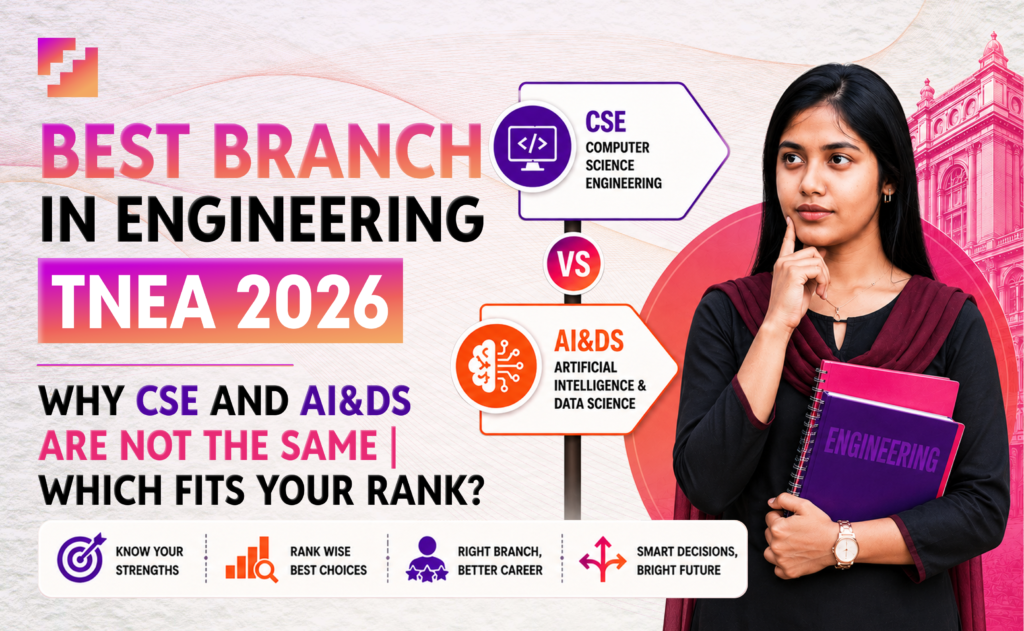
The problem with AI&DS in 2026 is that the name does too much work. “Artificial Intelligence and Data Science” sounds like the future. “Computer Science Engineering” sounds like what your seniors studied. Neither description tells you what actually happens inside the classroom or which one the job market rewards more consistently at your specific rank. Here’s what the name doesn’t tell you: CSE and AI&DS have different curriculum structures, different specialisation depths, and increasingly different placement profiles. A student who picks AI&DS because it sounds impressive, without understanding what the degree actually demands is making a four-year decision based on a five-second impression. The best branch in engineering for TNEA 2026 isn’t the one that sounds best in July. It’s the one that still makes sense in the placement season of 2030.
CSE and AI&DS: Why Most Students Think They’re the Same?
Here’s where the confusion starts. Both CSE and AI&DS:
- Are offered under engineering colleges
- Involve programming and software development
- Lead to IT company placements
- Carry similar fee structures at most colleges
So why does it matter which one you pick? Because CSE and AI&DS have fundamentally different curriculum structures, different specialisation depths, and in 2026, increasingly different placement profiles. The surface similarity masks a meaningful difference in what each degree actually prepares you for.
What Is Computer Science and Engineering Course? And What It Actually Covers?
CSE is the broadest engineering branch in the technology space. The computer science and engineering course covers the full spectrum of computing from the fundamentals that have existed for decades to emerging areas being added to updated syllabuses.
Core areas in CSE:
- Data Structures and Algorithms: The foundation of every software interview
- Operating Systems and Computer Networks: How systems actually work
- Database Management Systems: How data is stored and retrieved
- Software Engineering: How large software is designed and built
- Theory of Computation: The mathematical foundations of computing
- Programming languages: C, Java, Python across multiple semesters
- Electives: Typically including AI, ML, Cloud Computing, Cybersecurity in autonomous colleges
What CSE prepares you for: A CSE graduate is a generalist, strong across the full stack of computing, capable of working in software development, systems engineering, data roles, product management, and increasingly AI-adjacent roles through electives and self-learning.
The honest truth about CSE: CSE’s strength is its breadth. Every top IT company; TCS, Infosys, Google, Microsoft, Amazon, recruits CSE graduates. The placement pipeline is the widest, the alumni network is the largest, and the interview preparation ecosystem (LeetCode, competitive programming, DSA) is built around CSE fundamentals.
What Is AI and Data Science Course? And What It Actually Covers?
AI&DS also called Artificial Intelligence and Data Science is a specialised engineering branch introduced specifically to address the growing industry demand for graduates who can work with data, machine learning models, and AI systems from day one.
Core areas in AI&DS:
- Machine Learning: Supervised, unsupervised, reinforcement learning
- Deep Learning and Neural Networks: The foundation of modern AI
- Data Analytics and Visualisation: Making sense of large datasets
- Natural Language Processing: How computers understand human language
- Computer Vision: How AI processes and interprets images
- Statistics and Probability: The mathematical backbone of AI
- Big Data Technologies: Hadoop, Spark, cloud data platforms
What AI&DS prepares you for: An AI&DS graduate is a specialist trained specifically for data science, machine learning engineering, AI research, and analytics roles. The scope of AI as a career field is expanding faster than almost any other specialisation in engineering.
The honest truth about AI&DS: AI&DS graduates have a stronger specialisation signal for AI and data roles, which can be an advantage in the hiring process for those specific roles. However, the placement pipeline is narrower than CSE in terms of total company volume, and the foundational software engineering preparation is slightly less broad.
CSE vs AI&DS: Side by Side
| Factor | CSE | AI&DS |
| Curriculum focus | Broad, all of computing | Specialised; AI, ML, Data Science |
| Programming emphasis | Strong; DSA, systems, software | Strong; Python, ML frameworks, data tools |
| Maths requirement | Moderate | Higher; statistics, linear algebra, calculus |
| Placement volume | Higher, more companies recruit CSE | Moderate; AI-specific roles growing fast |
| Starting salary range | ₹4–15 LPA (varies by college and company) | ₹5–18 LPA (for AI-specific roles) |
| TNEA 2026 cutoff | Higher, 3 to 8 marks above AI&DS at same college | Lower, accessible with a slightly weaker rank |
| Best for | Students who want maximum options | Students who want AI/data science specifically |
| Risk | None, most established branch | Moderate, depends on job market alignment |
Which Engineering Branch Is Best for Future: CSE or AI&DS?
This is the question every TNEA 2026 student is really asking and the honest answer depends on which future you’re picturing.
If your goal is a software engineering job at a large IT company (TCS, Infosys, Wipro, Cognizant): CSE is the safer, broader, more established path. These companies recruit CSE in the highest volumes.
If your goal is a data scientist, ML engineer, or AI researcher role: AI&DS is the more direct path. The specialisation signal is stronger, and the curriculum is purpose-built for these roles.
If you’re not sure what you want: CSE gives you more time to explore. Its breadth means you can pivot toward AI/ML through electives and projects without being locked into a single specialisation from year one.
The 2030 angle on scope of AI: AI is reshaping every industry healthcare, automotive, finance, manufacturing. The scope of AI as a career field is not shrinking. However, the students who will benefit most from AI specialisation are those who genuinely engage with the maths and the problem-solving it requires not those who chose it because it sounded impressive in 2026.
TNEA 2026 Cutoff Comparison: CSE vs AI&DS at Top Colleges
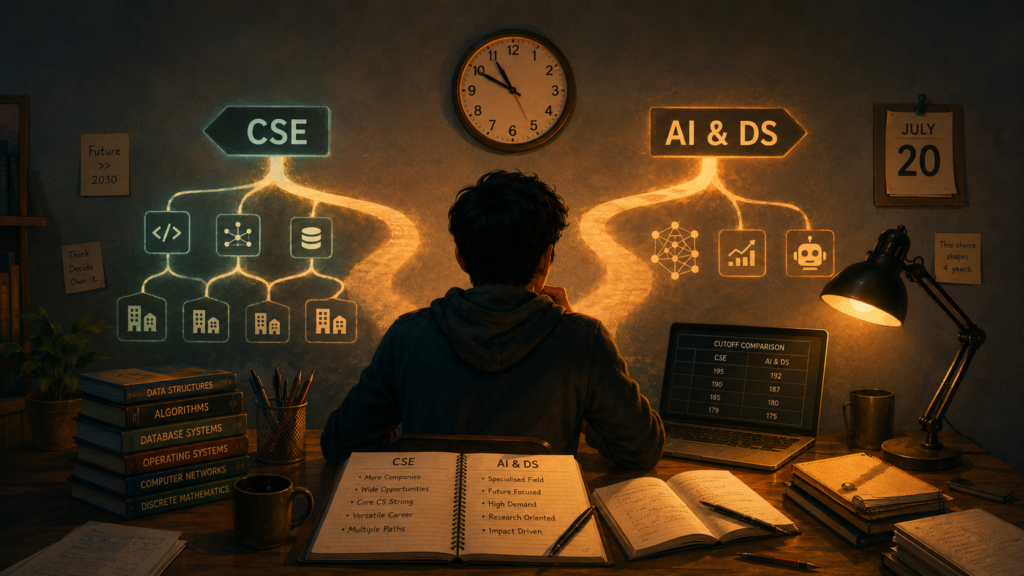
At every college in Tamil Nadu, CSE closes at a higher cutoff than AI&DS. This means:
- A student who just misses CSE at a college can often secure AI&DS at the same institution
- The college infrastructure, faculty, and placement cell are the same for both branches
- The only difference is the curriculum path and the specialisation depth
| College | CSE Closing Mark 2025 (OC) | AI&DS Closing Mark 2025 (OC) | Difference |
| Anna University CEG | 199.5 | 198.0 | ~1.5 marks |
| PSG College of Technology | 198.5–200 | 196–198 | ~2–3 marks |
| SSN College of Engineering | 194–196 | 192–194 | ~2 marks |
| Chennai Institute of Technology | 193–195 | 191–193 | ~2 marks |
| Kumaraguru College of Technology | 194–196 | 191–194 | ~3 marks |
| Sri Eswar College of Engineering | 189–193 | 186–190 | ~3–4 marks |
Key insight: The cutoff gap between CSE and AI&DS at most colleges is 2–4 marks not 10 or 15. This means a student choosing between CSE at a lower-ranked college vs AI&DS at a higher-ranked college should almost always prioritise the higher-ranked college, regardless of branch. College quality beats branch name at the same rank, securing AI&DS at PSG Tech is a stronger outcome than securing CSE at a lower-tier autonomous college.
The Decision Framework: Which Branch Fits Your Rank?
If your cutoff reaches CSE at your target college: Choose CSE if you want maximum flexibility. Choose AI&DS only if you’re specifically committed to a data science or AI career path.
If your cutoff reaches AI&DS but not CSE at your target college: Take AI&DS at the better college, don’t drop to a weaker college for CSE. The college matters more than the branch at this stage.
If your cutoff doesn’t reach either at your target college: Use your rank to find the best college where either branch is accessible, and prioritise college quality over branch name.
The one question that settles it: Do you want to keep all your options open or do you specifically want to work in AI, data science, or machine learning? If the answer is “keep options open”, CSE. If the answer is “specifically AI/data”, AI&DS.
What TNEA 2026 Students Must Know Before Choice Filling?
Choice filling for TNEA 2026 Round 1 opens July 20. Before you fill your preferences, decide this sequence clearly:
1. College first, branch second. A better college with AI&DS beats a weaker college with CSE in placements, in peer quality, and in career outcomes.
2. Fill both CSE and AI&DS at every target college. Put CSE first at each college; if your rank secures it, you get it. If not, AI&DS at the same college is your fallback. This maximises your outcome at every college on your list.
3. Don’t choose AI&DS just because it sounds more impressive in 2026. The job market rewards competence, not branch names. A strong CSE student with ML projects will outperform a weak AI&DS student with a shinier degree label.
The branch you pick in July 2026 shapes your career in 2030. Here’s what that market actually looks like: Best Engineering Course After 12th: AI-Powered Degrees Changing 2030 Placements
Check official TNEA 2026 choice filling details at tneaonline.org
Author
