

During TNEA 2026 counselling, thousands of students will stare at a college list and ask the same question their parents can’t answer: what does “autonomous” actually mean? and does it matter which one I pick? It matters more than most families realise. The difference between an autonomous college and an affiliated one isn’t just a label on a brochure. It affects the syllabus you study, the exams you write, the electives you can choose, and in many cases, the placements you walk into at the end of four years. This guide covers everything, what autonomous status actually means in Tamil Nadu, how it compares to affiliated colleges, and how to use that comparison to make a better TNEA 2026 decision.
What Is an Autonomous College? .. Simply Explained
An autonomous college is an engineering college that has received special recognition from Anna University, and in some cases from the UGC to design and manage its own academic processes independently. In practical terms, what is meant by autonomous college status is this: the college sets its own syllabus, conducts its own internal assessments, designs its own question papers, and evaluates its own students, all under a broader framework that Anna University oversees. However, the degree certificate at the end of four years is still issued by Anna University, not by the college itself.
So the autonomy is in the process, not in the credential. The degree carries the same Anna University name regardless of whether the college is autonomous or not.
See which Coimbatore colleges are autonomous and whether they actually deliver on it: Top 10 Engineering Colleges in Coimbatore 2026: NIRF Rankings & Complete Guide
What Is a Non-Autonomous College? And How Is It Different
A non-autonomous college, also called an Anna University affiliated college; operates under a fixed academic structure set entirely by Anna University. The university defines the syllabus, sets the question papers, conducts the evaluation, and issues the results. The college itself has very little room to deviate from this structure. If Anna University updates its syllabus once every three to four years, every affiliated college updates at the same time, whether the update reflects current industry needs or not.
Over 410 engineering colleges operate under Anna University admissions in Tamil Nadu. Of these, more than 180 hold autonomous recognition, meaning they have earned the right to operate with greater academic independence than the remaining affiliated institutions.
The 6 Key Differences — Autonomous College vs Non-Autonomous
| Factor | Autonomous College | Non-Autonomous (Affiliated) College |
| Syllabus design | College designs its own, updates independently | Fixed by Anna University, updated on AU’s schedule |
| Exam papers | College sets its own question papers | Anna University sets all question papers |
| Evaluation | Internal evaluation by the college | Centrally evaluated by Anna University |
| Results | Issued under AU oversight but processed internally | Fully managed by Anna University |
| Electives | Wide range, updated regularly with industry input | Limited, aligned to AU syllabus |
| Degree certificate | Issued by Anna University | Issued by Anna University |
The most important row in that table:
The degree certificate is the same. Both types of colleges produce Anna University graduates. The difference is entirely in the journey; not the destination credential.
Why Autonomous Colleges in Tamil Nadu Often Have Better Placements?
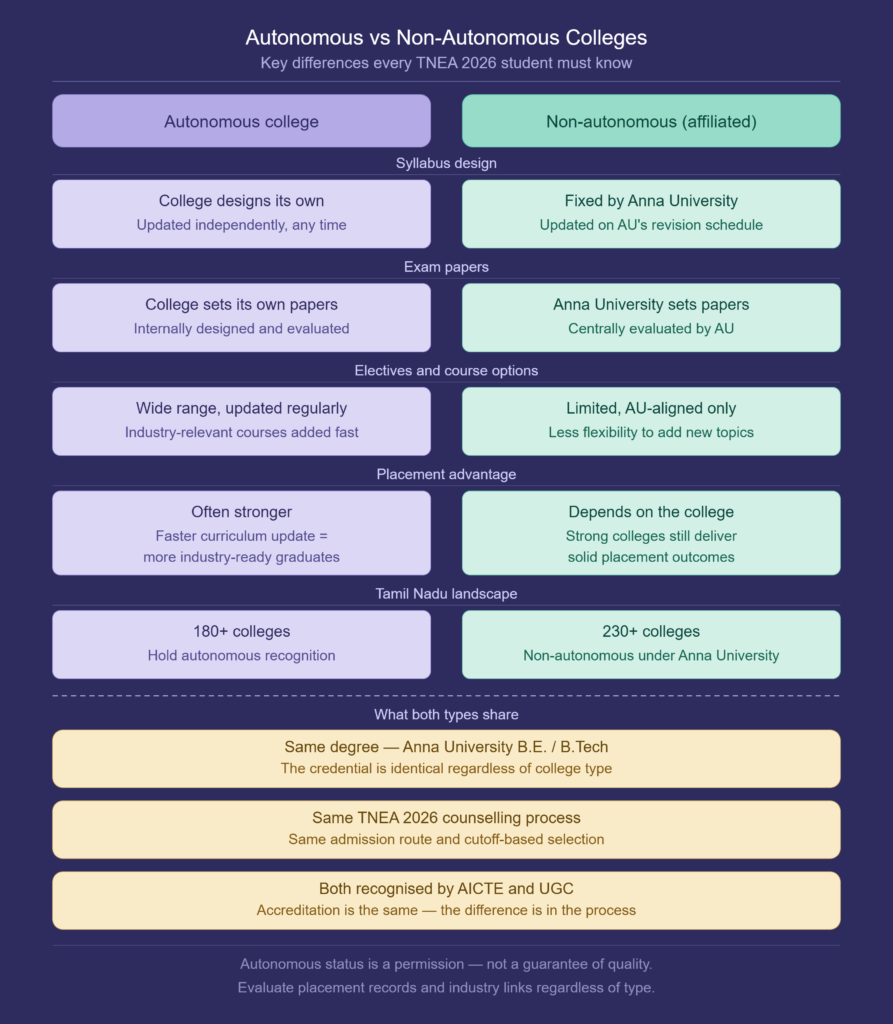
This is the part of the autonomous vs non-autonomous conversation that matters most for career guidance.
Autonomous colleges in Tamil Nadu have a structural advantage when it comes to placements, not because the degree is worth more, but because the curriculum can be updated faster. When a company starts hiring for a new skill set say, machine learning, cloud computing, or data analytics, an autonomous college can integrate that into its curriculum within a semester or two. An affiliated college has to wait for Anna University’s next syllabus revision cycle.
That gap in curriculum responsiveness directly impacts how industry-ready graduates are. Companies that recruit from autonomous colleges in Tamil Nadu often report that students are already familiar with the tools and technologies the role requires, because the college updated its syllabus to match industry demand before the students graduated.
However, this advantage only holds for well-run autonomous colleges. There are also autonomous colleges with poor management, low placement rates, and outdated curricula despite their autonomous status. Autonomous recognition is a permission, not a guarantee of quality.
Now that you know what autonomous means, here’s how Chennai’s top 10 measure up: Top 10 Engineering Colleges in Chennai 2026: NIRF Rankings & Complete Guide
Similarities: What Both Types Share?
The autonomous vs non-autonomous comparison often overshadows what both types have in common and those commonalities matter for career guidance decisions. A strong non-autonomous college with good faculty, active industry partnerships, and a serious placement cell will consistently outperform a weak autonomous college that has the status in name only. The label matters less than the execution.
| Similarity | Both Autonomous and Non-Autonomous Colleges |
| Degree | Anna University B.E./B.Tech degree |
| Eligibility | Same TNEA 2026 counselling process |
| Recognition | Both recognized by AICTE and UGC |
| Exam structure | Both follow semester-based patterns |
| Career paths | Both produce graduates for the same job market |
How to Evaluate Any College Before Choosing? Autonomous or Not
Before using autonomous vs non-autonomous as the deciding factor in TNEA 2026 counselling, ask these five questions about every college on your list:
Does the college have consistent, verifiable placement data not just a highlighted highest package, but the median salary across all placed students? Are there named company partnerships, or just a vague claim of ‘industry exposure’? Check whether the placement record holds across multiple branches, or only in CSE. Have former students or seniors reviewed the college positively for academic quality and campus culture? Finally, does the fee structure make financial sense for the placement outcomes the college actually delivers?
A non-autonomous college that answers “yes” to all five questions will serve a student better than an autonomous college that answers “no” to most of them.
The Honest Summary: Which Should You Choose?
For most TNEA 2026 students choosing between two colleges of similar reputation and cutoff range, the autonomous college is generally the better choice, because the curriculum flexibility it offers translates into better industry alignment and, in well-run institutions, better placement outcomes.
However, for students choosing between a well-established non-autonomous college with a strong track record and a lower-ranked autonomous college with average placements, the non-autonomous option is the stronger pick. Autonomous status alone does not make a college among the best engineering colleges in Tamil Nadu.
The honest answer to “autonomous or non-autonomous?” is this: it’s the wrong question to ask first. The right questions are about placement records, faculty quality, industry exposure, and fee-to-outcome ratio. Autonomous vs non-autonomous comes after those.
Check official TNEA 2026 college list and counselling details at tneaonline.org
Author
