
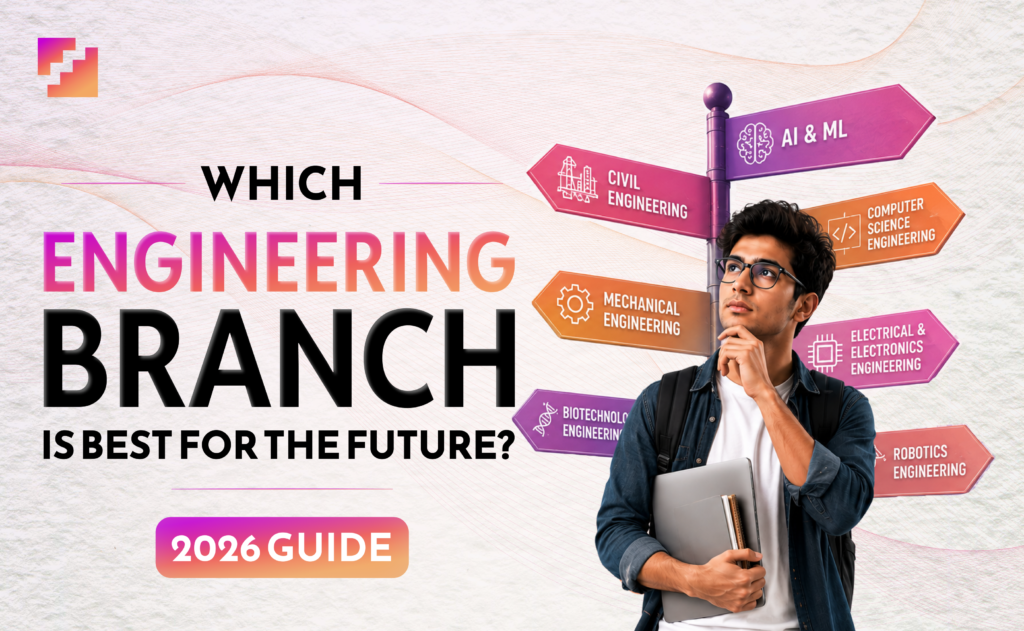
Every year, after boards, after ranks, after two years of sacrificing sleep and weekends, a student sits at a table with one question that no one ever answered honestly, which engineering branch is best for the future? . Not for their parents, not for the neighbour who got into NIT, but for the next twenty years of their own life. Because the students who got this right did not just earn more.. They built careers that did not need escaping. Also the ones who got it wrong spent years wondering why Monday mornings felt heavier than they should. This is the 2026 guide that answers it with real data, real salaries, and no shortcuts.
Which engineering branch is best for the future?
Not for today. Not for the next placement season. Rather, for the next twenty years.
It is the right question to ask. In fact, the world your parents graduated into where a degree was enough is gone. Instead, the world you are entering rewards people who picked the right direction early and went deep. So let us answer this properly, with data from NASSCOM, the World Economic Forum, and India’s own industry reports not opinions.
Why 2026 Is a Turning Point for Engineering Careers?
Three things are happening simultaneously in India right now that make branch selection more consequential than ever before.
First, the India Semiconductor Mission has committed ₹1.6 lakh crore to chip manufacturing, creating thousands of VLSI and hardware engineering roles that simply did not exist five years ago. Second, India’s EV market is projected to hit $100 billion by 2030, reshaping what Mechanical Engineering means as a career. Third, NASSCOM projects India will need over one million AI professionals by 2026, with only 16% of the current IT workforce holding AI skills.
These are not trends. In fact, they are structural shifts. And they point clearly toward which engineering branches are built for the future and which are not.
Which Engineering Branch Is Best for the Future in India, Branch by Branch:
1. AI & Machine Learning Engineering
If you ask which branch of engineering is best for the future right now, the data points here first. AI job demand is growing at 67%+ annually. Freshers at product companies earn ₹18–28 LPA from day one. The talent gap between demand and supply is so wide that companies are not just hiring they are competing. This branch is not a peak. Rather, it is a foundation that every other industry is being rebuilt on top of.
2. Computer Science Engineering (CSE)
CSE remains the safest, widest, and most flexible answer to which engineering branch is best for future planning. The salary range ₹6 LPA at service companies to ₹40 LPA at product companies reflects a branch where your outcome is almost entirely determined by your preparation, not your college. Furthermore, add an AI or cloud specialisation within CSE and the ceiling becomes genuinely difficult to define.
This is also the branch we covered in depth in our Top 10 Engineering Branches with Highest Salary guide worth reading alongside this one.
Emerging Branches You Shouldn’t Ignore in 2026
3. VLSI & Semiconductor Engineering (ECE)
This is the most underrated answer to which is the best branch in engineering for the future right now. India’s semiconductor investment is government-backed, decade-long, and desperately short of skilled engineers. VLSI specialists earn ₹12–30 LPA at entry level packages that rival product-company CSE roles. Qualcomm, Intel, and Samsung are all expanding R&D operations in India. The engineers who get there first will write their own terms.
4. Electrical & Electronics Engineering
The electric vehicle revolution is not coming. It arrived. And it needs EEE engineers who understand battery systems, power electronics, and drivetrain design. Tata Motors, Mahindra, and Hyundai India are actively recruiting on campuses for EV roles. A general EEE graduate earns ₹4–6 LPA. An EEE graduate who specialises in EV systems earns ₹10–18 LPA at the same companies. Same branch, different preparation, very different outcome.
5. Cybersecurity Engineering
India recorded 1.59 million cybersecurity incidents in 2023 alone, according to CERT-In. The country faces a shortage of 8 lakh cybersecurity professionals, a gap that is widening every year. Fresher salaries start at ₹8–15 LPA and senior roles cross ₹40–50 LPA. Competition is structurally lower than CSE because fewer students choose this path which makes it one of the smartest answers to which engineering branch is best for the future for students who want strong pay with less crowded entry points.
The One Insight That Changes Everything
The World Economic Forum’s Future of Jobs Report identifies analytical thinking, AI literacy, and systems thinking as the three most in-demand skill clusters through 2030. Every branch above either builds those skills directly or rewards people who layer them on top.
Which means the honest answer to which engineering branch is best for the future is not a single branch name.
It is this: pick the branch where India’s structural demand is growing, where the talent gap is real, and where you can go deep enough to become genuinely hard to replace.
That intersection demand, scarcity, and depth is where the best engineering careers of the next decade will be built.
Quick Reference ~ Best Engineering Branches for the Future (India 2026)
| Branch | Future Demand | Fresher Salary | Best For |
| AI & ML Engineering | 67%+ growth | ₹18–28 LPA | Tech / Startups |
| CSE / Software | 25%+ growth | ₹6–40 LPA | Product Companies |
| VLSI / Semiconductor | Surging (govt-backed) | ₹12–30 LPA | Chip Design |
| EEE — EV Track | EV: very high | ₹10–18 LPA | Auto / Manufacturing |
| Cybersecurity | High, low competition | ₹8–15 LPA | Banking / Fintech |
Sources: NASSCOM, CERT-In, AmbitionBox, IIT Placement Reports 2025–26
Author
