

Picture this. It’s the first round of TNEA counselling 2026. You’ve been allotted a seat; not your dream college, but a decent one. Your phone is buzzing with messages. One voice note comes from your cousin, who graduated three years ago: ‘Don’t accept yet, wait for round two.’ Meanwhile, your neighbour, whose son got into a ‘better’ college last year is telling your parents the exact opposite. Everyone has an opinion. Nobody has your rank. So here’s the only question that actually matters tonight: is your cutoff safe enough to wait, or are you one risky decision away from losing the seat you already have? Let’s actually answer that not with vague reassurance, but with how TNEA counselling 2026 really works.
First, Understand What “Waiting” Actually Means in TNEA Counselling 2026
A lot of students think “waiting” means doing nothing. It doesn’t. When your TNEA counselling 2026 allotment comes through, you get options not just “accept” or “reject.” You can choose Accept and Upward, which means you keep the seat TNEA has given you while it still considers you for something higher up your preference list. If a better option opens up, you move. If it doesn’t, you stay exactly where you are. This is the safety net most students don’t realise exists. Waiting isn’t a gamble where you lose everything if it doesn’t work out. It’s more like holding a reservation while you keep checking if a better table opens up. The real risk only shows up when you choose Decline and Upward, where you give up your current seat entirely to chase something better. That’s the move that needs real cutoff math behind it, not guesswork.
So, What Cutoff Is Actually “Safe” to Wait On?
Here’s the honest answer: there’s no single number that works for everyone. But there is a way to figure out your number. TNEA counselling 2026 doesn’t run in fixed, identical rounds for every student. It moves in phases based on rank ranges TNEA calls your phase only when candidates in your rank bracket are due for processing. In recent years, this has stretched across 7 to 10 phases before supplementary counselling even begins.
That detail matters more than most students realise. If your rank sits comfortably inside the top portion of a rank bracket for your category, your cutoff is generally safer to wait on, there’s real room above you and real demand below you, which means seats tend to shuffle in your favour as rounds progress. If your rank sits right at the bottom edge of a bracket, waiting becomes riskier, because the seat you’re holding might be the best version of itself you’ll see.
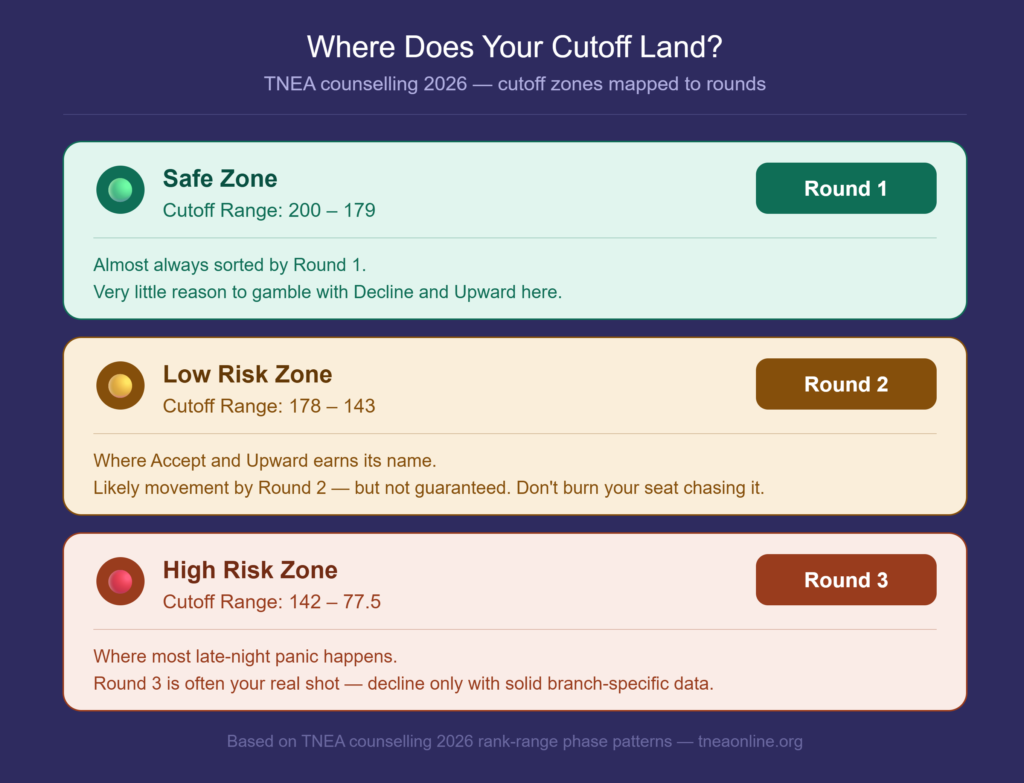
Here’s a rough way to map your cutoff against the rounds it’s likely to clear:
| Zone | Cutoff Range | Round |
| 🟢 Safe Zone | 200 – 179 | Round 1 |
| 🟡 Low Risk Zone | 178 – 143 | Round 2 |
| 🔴 High Risk Zone | 142 – 77.5 | Round 3 |
If your cutoff lands in the Safe Zone, you’re almost always sorted by Round 1, there’s very little reason to gamble with Decline and Upward here. The Low Risk Zone is where Accept and Upward earns its name; you’ll likely see movement by Round 2, but it’s not guaranteed, so don’t burn your current seat chasing it. The High Risk Zone is where most of the late-night panic happens, Round 3 is often your real shot, and declining a seat in this range without solid branch-specific data is how good options disappear overnight.
The Mistake That Costs Students Their Seat Every Single Year
Here’s a story that repeats itself every counselling season, with a different name attached each time. A student gets allotted a reasonably good college, but not the branch they wanted. Their rank is just slightly above last year’s closing cutoff for their dream branch. Excited, hopeful, and a little impatient, they hit Decline and Upward, fully expecting the next phase to deliver something better. It doesn’t. It doesn’t. The seat is gone, and the phase moves on without looking back. They’re now stuck waiting for supplementary counselling, hoping something, anything opens up in August.
This isn’t a rare horror story. It’s the single most common regret students post about after TNEA counselling 2026 wraps up. The fix isn’t complicated: never decline a seat unless your rank is clearly, comfortably better than last year’s closing cutoff for what you’re chasing, not just marginally better, not “it might work out” better.
How to Actually Check If You’re Safe?
Don’t rely on cousin-advice or neighbour-gossip. Do this instead.
Pull up the cutoff trends from the last two counselling cycles for your specific target college and branch, not the college’s overall cutoff, the branch-specific one. Branches inside the same college can have wildly different closing ranks. CSE and Civil at the same college are not playing in the same league. Compare your rank against that branch-specific cutoff, not the general one.
Then check your category’s bracket separately, since BC, MBC, and OC cutoffs move at completely different paces through the phases. If your rank beats last year’s closing cutoff by a meaningful margin not by one or two points, you’re likely safe to wait. If you’re hovering right around it, treat your current allotment like it’s the best offer you’re going to get, and lean toward Accept and Upward instead of declining outright.
Check your branch-specific cutoff trends directly on tneaonline.org before deciding.
What I’d Actually Tell a Friend
If a friend asked me this exact question right now, here’s what I’d say without sugar-coating it. Don’t decline a seat out of pride or peer pressure. Use Accept and Upward as your default move, it costs you nothing and protects you completely. Only consider declining if your rank gives you real, comfortable breathing room above last year’s cutoff for what you actually want. And honestly, talk to seniors who went through TNEA counselling 2026’s exact phase structure this year, not someone who counselled three years ago when the rules were slightly different. The phases, the brackets, the pacing, these shift every year.
Your rank already did its job. Now it’s about playing the rounds smart, not fast.
Author
