

Tamil Nadu builds more cars, more chips, and more machines than almost any other state in India. So why do Tamil Nadu engineering graduates still struggle to get jobs? The numbers are uncomfortable. Tamil Nadu engineering graduates face an unemployment rate of 16.3%, meaningfully higher than the national average of 13.4%. Youth unemployment in the state stands at 17.5%, almost double the national figure of 10%. This is happening in a state with the highest number of factories in the country. If the industry exists, if the factories exist, if the jobs exist; why are 80% of Tamil Nadu engineering graduates still struggling to get jobs, and how to avoid it? This article answers that question honestly, with 2026 data and more importantly, tells you exactly how to make sure you are not one of the 80%.
The Numbers Behind the 80%: A 2026 Snapshot
Before getting into the reasons, here is the data that frames this entire conversation. The most telling detail here is the gap between graduate unemployment in Tamil Nadu and the national average. Despite having a stronger industrial base than most states, Tamil Nadu’s graduates including engineering graduates are struggling more than their counterparts elsewhere in the country.
| Metric | Tamil Nadu | National Average |
| Graduate unemployment rate | 16.3% | 13.4% |
| Youth unemployment (15–29 age group) | 17.5% | 10% |
| Workforce in informal sector | 65.7% | 74.3% |
| CS/IT engineering employability (2026) | ~80% | ~80% |
| Overall engineering employability (2026) | ~70.15% | ~70.15% |
Source: Periodic Labour Force Survey (PLFS), Madras Institute of Development Studies, India Skills Report 2026
80% struggle. The other 20% chose differently; starting with their college: Best Engineering College or Not? Here Is How to Find Out
Reason 1: Too Many Graduates, Same Number of Jobs
Tamil Nadu has one of the highest Gross Enrolment Ratios (GER) in higher education in India, nearly double the national average. In simple terms, a far larger share of young people in Tamil Nadu go on to pursue degrees, including engineering, compared to most other states. This sounds like good news. However, the formal job market has not expanded at the same pace. Every year, more engineering colleges open, more seats get filled, and more Tamil Nadu engineering graduates enter the workforce, but the number of formal-sector jobs requiring an engineering degree has grown far more slowly. The result is a structural oversupply: more qualified candidates than there are matching roles, regardless of how good the economy looks on paper.
This is not a story of “no jobs.” It is a story of too many people chasing the same set of jobs.
Reason 2: The Skills Gap Industry Keeps Flagging
For years, industry leaders and bodies like NASSCOM have repeatedly pointed to the same issue, a large share of engineering graduates in India are simply not ready for the jobs they are qualified for on paper. In 2026, “not industry-ready” usually means weak coding proficiency under real time pressure, limited ability to solve ambiguous real-world problems, poor communication skills in interviews and team settings, and little to no project portfolio beyond mandatory academic work. This gap exists even among Tamil Nadu engineering graduates with strong academic scores. A high mark in semester exams does not automatically translate into the skills recruiters are testing for in 2026, particularly as hiring shifts toward AI, automation, and data-driven roles.
Reason 3: Why Tamil Nadu Engineering Graduates Get Wildly Different Outcomes?
This is arguably the most important reason, and the one most overlooked. “Engineering graduate” is treated as a single category. In reality, the employability gap between branches and qualification types is enormous. A Tamil Nadu engineering graduate from a Computer Science background enters a job market where roughly 4 out of 5 candidates find suitable employment, according to the India Skills Report 2026. A graduate from certain other branches, or with a diploma-level qualification, faces dramatically tougher odds, sometimes less than half, with ITI diploma holders sitting at around 45.95% employability and polytechnic diploma holders at roughly 32.92%. The “80% struggle” headline is, in reality, an average. For some branches and skill profiles, the struggle rate is far lower. For others, it is far higher. Branch choice and skill-building matter enormously, arguably more than the degree itself.
Reason 4: Gig Work Is Hiding the Real Numbers
Here is something rarely discussed in placement statistics. Many Tamil Nadu engineering graduates, unable to find roles matching their qualification, take up gig economy work, food delivery, ride-hailing, and similar platforms, while they wait for “something better” to come along. Technically, these graduates are employed. They have income. They are not counted as unemployed in many surveys. However, this masks the real scale of underemployment. A trained engineer delivering food is not using their degree, is not building relevant experience, and critically is not using the early years after graduation to close the skills gap described in Reason 2. Each year spent in gig work without skill-building makes the eventual transition into a suitable role harder, not easier.
How to Avoid It ~ What 2026 Hiring Actually Rewards
This is the section that matters most if you are a current student or recent graduate. 2026 hiring in India is being reshaped by a few clear trends, AI and machine learning, data analytics, electric vehicles, and semiconductor manufacturing. According to the India Skills Report 2026, AI and ML-related roles have seen explosive growth, and CS/IT graduates continue to lead employability figures.
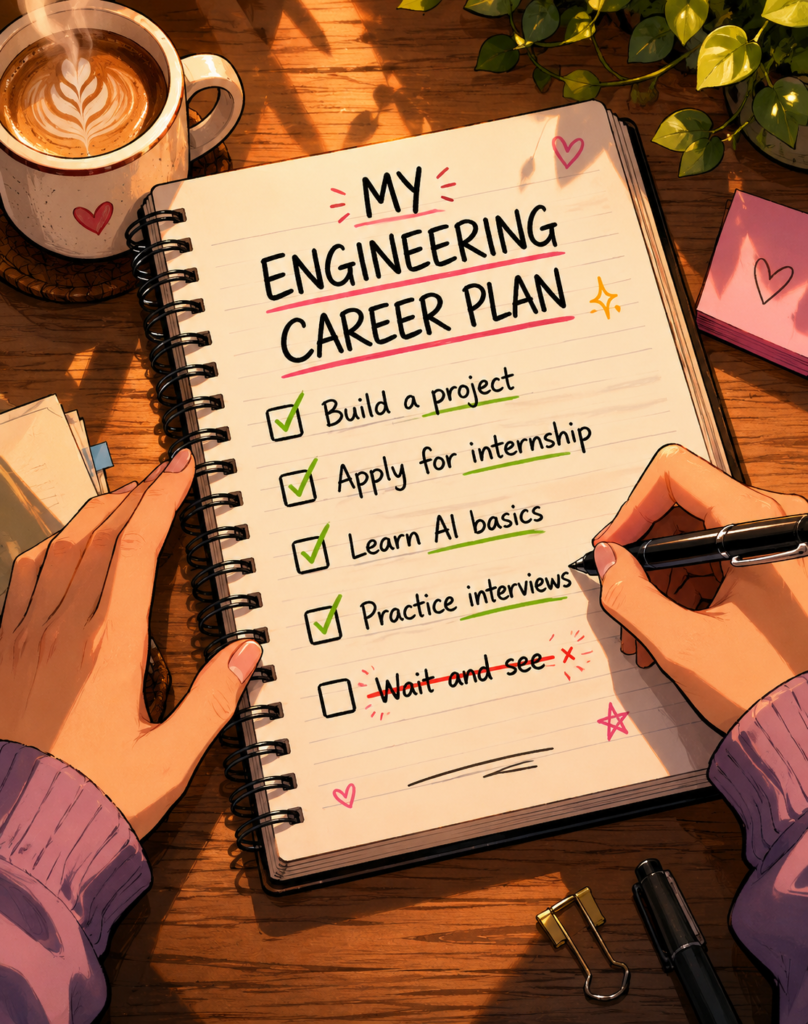
Here is what Tamil Nadu engineering graduates can do, starting now, to position themselves in the right group.
- Build a project portfolio outside coursework. Recruiters increasingly weigh real, self-driven projects over academic scores alone, a working app, a small automation script, or a documented engineering build matters more than another certificate.
- Prioritize internships, even unpaid ones. Direct industry exposure closes the “not job-ready” gap faster than any classroom can. Six months in a real work environment teaches things no textbook covers.
- Target skills tied to 2026 demand AI, data analytics, and automation. These areas show the strongest employability growth, regardless of which branch you studied.
- Choose colleges based on real industry tie-ups, not brand name alone. A college with genuine project-based learning and active company partnerships often outperforms a “famous” one with a passive placement cell.
- Treat communication as a core skill, not an extra. Interviews and team roles consistently filter out technically strong but poorly communicating candidates, this is one of the easiest gaps to close with practice.
- The single biggest shift in mindset that helps is this, stop treating the degree as the finish line. In 2026, the degree is the entry ticket. What you build alongside it determines whether that ticket gets used.
The Degree Opens the Door. Skills Decide What’s Behind It.
The 80% figure is real. However, it is not a story about individual failure. It is a story about a system that scaled up the number of engineering graduates in Tamil Nadu far faster than it scaled up the skills, exposure, and industry alignment needed to employ them. The oversupply is real. The skills gap is real. The branch-wise disparity is real. And the gig economy is quietly absorbing and hiding a large part of this struggle.
But here is the part that should give you hope, not anxiety. Every reason listed in this article is something an individual student can act on, regardless of which college they attend or which branch they are already enrolled in. Projects can be built. Internships can be sought. Skills in AI and data analytics can be learned outside the classroom. Communication can be practiced. The Tamil Nadu engineering graduates who avoid the 80% are not necessarily the ones with the highest marks or the most famous college names. They are the ones who started treating their degree as the beginning of their preparation, not the end of it.
Start now. The gap is real, but so is the way around it.
Author
