
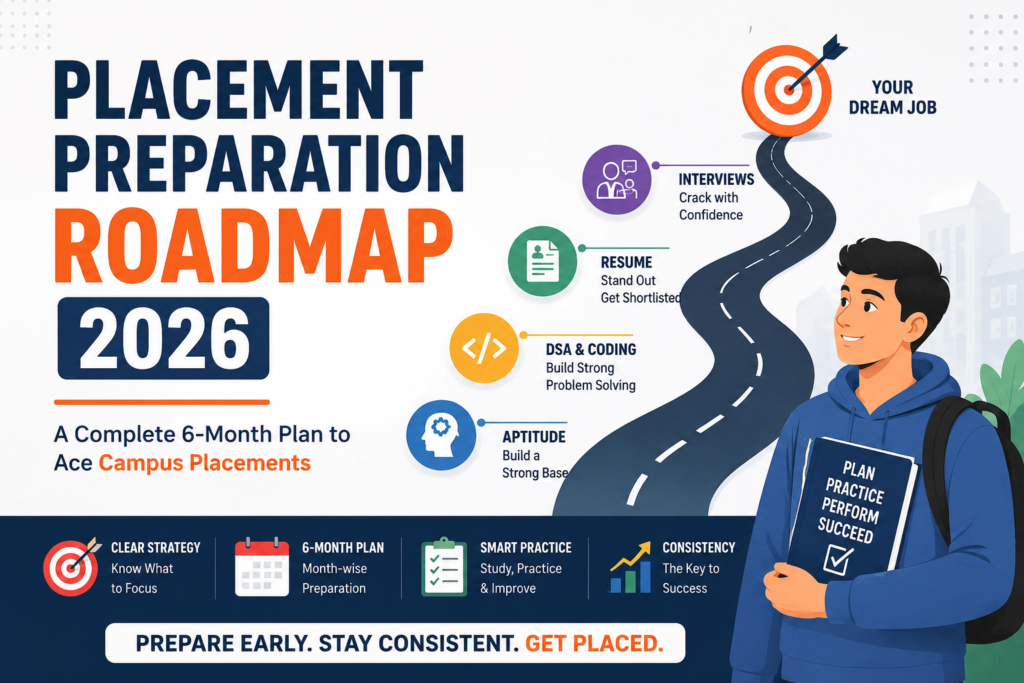
Placement Preparation Roadmap 2026 is for engineering students who want to walk into placement season feeling prepared, not panicked. Here’s the truth: solving a few coding questions every day or memorizing aptitude shortcuts isn’t enough. Campus placements test a lot more than that.
Over the next six months, you’ll gradually build the skills that companies actually look for. One week, you might be working on DSA. The next, you’ll be revising DBMS or improving your resume. Somewhere along the way, you’ll practice mock interviews, work on your communication skills, and figure out how different companies structure their hiring process. That’s how real preparation works—it grows layer by layer instead of happening overnight.
Whether you’re aiming for a service-based company or dreaming of landing a product-based role, this roadmap helps you stay focused on what matters. Follow it consistently, put in the effort every week, and by the time placement drives begin, you’ll be far more confident than students who start preparing at the last minute.
Six structured months is more than sufficient for most roles at service and mid-tier product companies. For FAANG-level roles, 8 to 12 months of intensive preparation is typical. Therefore, identify your target company tier before you start and calibrate your timeline accordingly.
Table of Contents
-> Placement Preparation Roadmap 2026: How Campus Placements Work
-> Placement Preparation Roadmap 2026: Company Types and Hiring Process
-> Placement Preparation Roadmap 2026: Aptitude Preparation Guide
-> Resume and LinkedIn Guide
-> Interview Preparation
-> Common placement preparation mistakes to avoid
Placement Preparation Roadmap 2026: How Campus Placements Work
Before building your placement preparation roadmap, understand the process you are preparing for. Most companies follow a fixed structure: an online aptitude test, a technical or coding round, a technical interview covering CS fundamentals and projects, and finally an HR interview.
The key insight most students miss is that each stage is a filter, not just a formality. A strong interview performance cannot compensate for a poorly built resume that ATS rejects before a human reads it, and clearing the aptitude test just gets you through the front door; it guarantees nothing if your technical basics are shaky. Therefore, every stage needs structured preparation, not just the coding round.
Placement Preparation Roadmap 2026: Company Types and Hiring Process
Your preparation strategy changes significantly based on which company type you target. Moreover, preparing for product companies when your realistic target is a service company wastes weeks on irrelevant material. Match your preparation to your actual goal.
| 1. Service Companies (₹3.5 to ₹7 LPA) Companies: TCS, Infosys, Wipro, Cognizant, Capgemini, Accenture What they actually test: Speed and accuracy over complex logic. Mentor Advice: Don’t waste three months trying to master Graph algorithms if your main target is TCS or Cognizant. In our training batches, students who secure offers here win on timed quantitative speed and basic pseudocode comprehension, not advanced dynamic programming. |
Apply to every company that visits your campus and meets your minimum criteria. Volume matters — most freshers get placed after 3 to 7 interview attempts, not the first. Therefore, never skip a company just because it is not your first choice.
Placement Preparation Roadmap 2026: 6-Month Study Plan
This six-month placement preparation roadmap works for students targeting service companies and mid-tier product roles. Adjust the timeline based on when your placement season opens at your college.
Months 1 and 2: Build your foundation
Master the ‘Big 4’ Quant Topics: Spend most of your time on percentages, ratios, time/speed/distance, and profit/loss. Believe it or not, these four areas alone cover almost half the questions you’ll see in typical service company tests.
Start DSA on Day One: A huge mistake is waiting until you “finish” aptitude to start coding. Pick one language like C++, Java, or Python and don’t switch. Try to split your time every day, doing about 45 minutes of math and 45 minutes of basic array or string problems.
Quick Tip: If you’re on the fence about which language to choose, go with C++ or Java if you eventually want to apply to product companies. They actually force you to learn how memory works and build a much stronger foundation in OOP.
Months 3 and 4: Speed and intermediate DSA
- Shift from concepts to speed
Solve previous year placement papers from TCS, Infosys, Wipro, and Accenture under timed conditions — 30 to 45 minutes per section. Target 20 to 25 questions per section within that window. - Advance your DSA coverage
Move to linked lists, stacks, queues, binary search, and recursion. Additionally, start practising DBMS fundamentals since SQL questions appear consistently in technical rounds. - Write your resume first draft
Do not wait until placement season opens to start your resume. A rough first draft now gives you time to refine it properly over the next two months.
Timed aptitude mock tests Previous year company papers Linked lists and stacks Binary search and recursion DBMS fundamentals
Month 5: CS fundamentals and resume finalisation
- Cover core CS subjects thoroughly
OOP concepts, DBMS and SQL queries, operating systems basics, and computer networking fundamentals come up consistently in technical rounds at every company type. - Finalise your resume and LinkedIn profile
Both must be ready before placement season opens. ATS scans your resume before any human reads it, so a single-column clean format with quantified impact statements is non-negotiable. - Prepare your project explanationEvery technical interview begins with your project. Prepare three clear talking points: what problem it solved, what technology it used, and what you would improve now.
OOP concepts DBMS and SQL OS basics Computer networks Resume finalised LinkedIn optimised
Month 6: Mock interviews and company-specific preparation
- Take full mock aptitude tests twice a weekSimulating real test conditions builds both accuracy and confidence. The real magic happens after the test: when you sit down and figure out why you got question #14 wrong.
- Run mock technical interviews with peers or mentorsSpeaking your thought process out loud under questioning is a skill that needs practice. Verbalising your approach often matters as much as reaching the correct solution in real interviews.
- Research each company before their drive opensEach company tests a distinct pattern. Keep an eye out for company quirks, too—like Capgemini’s game-based cognitive tests or TCS’s pseudocode section. Knowing this in advance lets you prepare specifically rather than generically.
Full mock aptitude tests Mock technical interviews HR question preparation Company-specific papers Advanced DSA revision
Placement Preparation Roadmap 2026: Aptitude Preparation Guide
The aptitude test eliminates 40 to 70 percent of applicants before the interview stage. It covers quantitative aptitude such as percentages, time-speed-distance, profit and loss, and number series; logical reasoning covering puzzles, coding-decoding, and seating arrangements; and verbal ability including reading comprehension, grammar, and vocabulary.
Recommended resources
- For Aptitude Concepts: Use R.S. Aggarwal to learn the formulas, but don’t try to solve all 500 questions per chapter. Pick 15–20 representative problems per topic, then quickly move to timed online practice.
- Fast Track Objective Arithmetic by Rajesh Verma for shortcuts and speed
- For Coding Practice: Skip random practice on LeetCode. Stick strictly to curated sets like the Blind 75 or NeetCode 150. Solving 75 patterns deeply will prepare you better than blindly completing 300 random problems without understanding the underlying logic.
- Previous year papers from your specific target company, since patterns differ significantly across companies
Company-wise aptitude patterns
| Company | Special section to prepare | Difficulty |
|---|---|---|
| TCS NQT | Programming logic and pseudocode | Medium |
| Infosys | Puzzle-heavy logical reasoning | Medium |
| Wipro Elite NTH | Written communication test | Easy to Medium |
| Cognizant GenC | Cloud literacy and data interpretation | Medium |
| Capgemini Exceller | Game-based cognitive test and pseudocode | Medium to Hard |
| Accenture | Cognitive and technical assessments | Easy to Medium |
Placement Preparation Roadmap 2026: DSA and Coding Guide
DSA preparation is where most students either over-invest or under-invest. Service companies require only 1 to 2 easy-to-medium coding problems. Mid-tier product companies expect solid DSA up to medium difficulty. Top product and FAANG companies, on the other hand, require advanced DSA including graphs, dynamic programming, and system design.
DSA topics by priority level
- Priority 1 — any role: arrays, strings, linked lists, stacks, queues, binary search, recursion, basic sorting
- Priority 2 — product companies: trees, heaps, hash maps, sliding window, two pointers, greedy algorithms
- Priority 3 — FAANG and top product: graphs, dynamic programming, backtracking, tries, segment trees
Coding platforms to use
- LeetCode — best for product company preparation. Start with the top 75 DSA questions before expanding further
- HackerRank — best for service company coding rounds, since TCS and Infosys use similar formats
- GeeksforGeeks — best for CS fundamentals alongside DSA practice
Attempting 500 LeetCode problems without understanding patterns is less effective than deeply understanding 75 to 100 problems across key categories. Pattern recognition — not memorisation — is what lets you solve unseen problems under interview pressure.
Placement Preparation Roadmap 2026: Resume and LinkedIn Guide
Your resume reaches an ATS before any human reads it. A poor format gets rejected automatically before the process even starts. Use a single-column, clean layout with no tables, graphics, or columns.
What makes a strong placement resume
- Quantify impact wherever possible — for example, “Reduced API response time by 40%” or “Built a feature used by 500 users”
- Keep it to one page for fresher roles, since recruiters spend an average of 6 to 8 seconds on the first scan
- List only skills you can explain under direct questioning, not a wishlist of every technology you have heard of
- Start every bullet point with an action verb: built, designed, reduced, implemented, optimised
LinkedIn profile essentials
- Write a specific headline — not just “Student at XYZ College” but something like “Full Stack Developer | DSA | React | Node.js | Seeking SDE Roles 2026”
- Write an About section of 3 to 5 sentences explaining what you build and what you are looking for
- Connect with alumni from your college working at target companies, since referrals significantly improve shortlisting rates
Placement Preparation Roadmap 2026: Interview Preparation
Interview preparation is the stage most students begin only after clearing the online test. Because of this, they walk into interviews completely underprepared for questions they could have handled easily with two to three weeks of focused practice beforehand.
Technical interview preparation
- Prepare your final year project explanation with three clear talking points: what problem it solved, what technology it used, and what you would do differently now
- Revise OOP concepts with real code examples, since interviewers ask you to implement inheritance, polymorphism, or abstraction on the spot
- Additionally, practise explaining your thought process before writing code, since the approach matters as much as the final solution
HR interview preparation
- Prepare specific answers for the 10 most common HR questions: tell me about yourself, where do you see yourself in 5 years, why this company, your greatest strength and weakness
- Confirm your relocation flexibility upfront if the company has multiple office locations, since this directly affects selection decisions
- Research the company’s recent news and products before every HR round so you can ask one informed question at the end
Common placement preparation mistakes to avoid
Understanding what not to do is as important as knowing what to do. These are the mistakes that consistently cost well-prepared students their placement opportunities.
Starting too late
Most students begin preparing 2 to 4 weeks before placement season. By that point, aptitude concepts cannot be built from scratch and DSA patterns cannot be internalised in time. Start at least 4 to 6 months before your campus placement season opens.
Ignoring the aptitude round
Strong coders who fail the aptitude test never reach the interview. This means you have to treat aptitude just as seriously as your coding practice. Specifically, practise timed mock tests at least twice a week throughout your preparation period rather than cramming them into the final week.
Using too many scattered resources
Switching between five aptitude books, three YouTube channels, and two practice platforms prevents deep learning. Instead, pick one book, one platform, and one channel per skill area and commit to them completely before expanding further.
Neglecting soft skills
Communication quality affects selection at every stage, from the aptitude essay round to the final HR interview. Keep in mind that many placement drives now also include spoken English assessments and video interviews as standard. Get into the habit of speaking clearly and confidently daily rather than only preparing written answers.
The bottom line
The Placement Preparation Roadmap 2026 is built on consistent preparation, a clear strategy, and an early start. Focus on aptitude, DSA, resume building, and interview skills to improve your placement opportunities. Apply to every eligible company, as each interview helps you gain valuable experience.
For structured guidance, FACE Prep Campus offers placement training, coding practice, aptitude preparation, and mock interviews to help students prepare with confidence.
Author
