
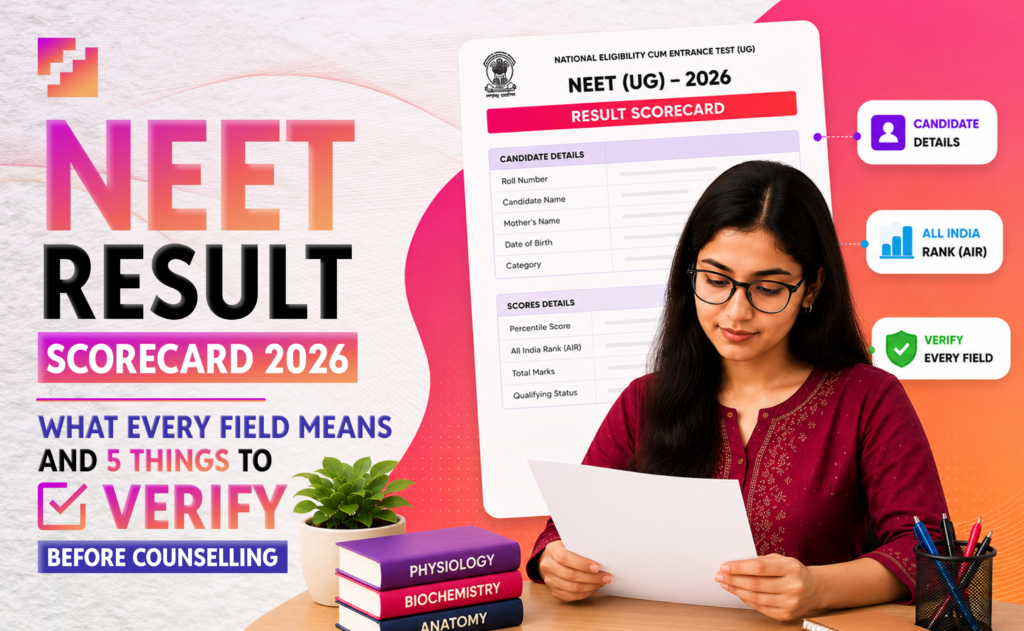
The NEET 2026 result is expected by July 20. In the minutes after it releases, most students will open their scorecard, look at two numbers, total marks and rank and close the tab. That’s a mistake. The NEET result scorecard 2026 contains eight distinct fields, each of which serves a different purpose in counselling. Two of them, the All India Rank and the category rank, determine which counselling process you compete in and which seat pool you draw from. One of them, the qualifying status; determines whether you can participate in counselling at all. And at least three of them are worth cross-checking against your registration data before counselling registration opens, because errors on the scorecard are easier to resolve before counselling begins than after. This guide explains every field on the NEET result scorecard 2026; what it means, what it’s used for, and what to do if something looks wrong.
When Will NEET 2026 Result Be Declared?
The NEET 2026 result is expected by July 20, 2026, based on official NTA statements and previous year patterns. An NTA senior official confirmed to ANI that the result will be announced by July 20. The exact time has not been confirmed, based on previous years, NTA typically releases results between 2 PM and 5 PM IST. The NEET result scorecard will be available for download at neet.nta.nic.in immediately after result declaration. Students must log in with their Application Number and Password or Date of Birth to access it.
Check official NEET 2026 result at neet.nta.nic.in
How to Download Your NEET Result Scorecard 2026?
1: Visit neet.nta.nic.in immediately after result declaration
2: Click on the “NEET UG 2026 Result” link on the homepage
3: Enter your Application Number and Password or Date of Birth
4: Enter the Security Code / CAPTCHA
5: Your scorecard will appear on screen
6: Download the PDF, save digitally and print at least 3 copies
7: Verify every field against your registration data before closing the tab
The portal experiences extremely high traffic immediately after result declaration. If the link doesn’t open, wait a few minutes and try again. Do not use third-party websites claiming to show results faster.
NEET Result Scorecard 2026: Every Field Explained

The NEET 2026 result scorecard contains the following fields. Here is what each one means and how it is used:
Field 1: Candidate Name
Your full name as entered during NEET 2026 registration. This must match exactly with your Class 10 certificate, Aadhaar card, and all other counselling documents.
Why it matters: A name mismatch between your scorecard and your identity documents is one of the most common reasons for seat cancellation during college reporting. Even a single letter difference — “Mohammed” vs “Mohammad” — can cause problems during verification.
Field 2: Application Number
Your unique NEET 2026 registration number. This is your login credential for all NTA portals and will be required for MCC counselling registration, state counselling registration, and any future NTA communication.
Why it matters: Keep this number saved in multiple locations. You cannot access your scorecard, counselling portal, or any NTA service without it.
Field 3: Roll Number
Your NEET UG 2026 examination roll number, different from your application number. This was printed on your admit card and is the number used to identify your answer sheet and OMR records.
Why it matters: Used for OMR sheet verification and any post-result discrepancy resolution.
Field 4: Date of Birth
Your date of birth as entered during registration. Must match your Class 10 certificate exactly.
Why it matters: Date of birth is used as a secondary login credential for NTA portals. A mismatch here means you cannot access your own scorecard after the initial download session.
Field 5: Subject-wise Marks
Your raw marks in each subject:
- Physics (out of 180)
- Chemistry (out of 180)
- Biology, Botany (out of 90) + Zoology (out of 90) = Biology total out of 180
Total: out of 720
Why it matters: Subject-wise marks are used to verify your score calculation. Cross-check each subject against your expected marks from the OMR sheet comparison. If any subject shows a significantly different score from your estimate, check your OMR sheet response first before assuming an error.
Field 6: Total Marks
Your overall NEET 2026 score out of 720. Calculated as:
(Correct answers × 4) − (Incorrect answers × 1)
With the bonus marks applied for the dropped Physics question (+4 for all) and the two-correct-answers Physics question (+4 for students who marked a correct option).
Why it matters: This is the number most students look at first. However, the total marks alone don’t determine where you get admission, the rank does. Two students with the same total marks can have different ranks due to tiebreaker rules.
Field 7: Percentile Score
Your percentile score indicates your performance relative to all other candidates who appeared in NEET 2026. A percentile of 95 means you scored higher than 95% of all candidates.
Why it matters: The qualifying cutoff is percentile-based, not marks-based. The General category qualifying cutoff is the 50th percentile, meaning you must score higher than 50% of all candidates to qualify. This is why the qualifying cutoff marks vary slightly each year depending on how everyone else performed.
Field 8: All India Rank (AIR)
Your national rank among all qualifying NEET 2026 candidates. NEET AIR 1 goes to the student with the highest score, based on the 2025 trend, AIR 1 typically corresponds to a score of 715–720.
Why it matters: AIR is the primary determinant for 15% All India Quota (AIQ) counselling conducted by MCC. Lower AIR = better rank = higher priority in seat allotment.
Tiebreaker rule: When two candidates have identical total marks, the student with higher Biology marks gets the better rank. If Biology marks are also equal, the older candidate gets priority. If date of birth is also identical, the random number assigned during registration decides the rank.
Field 9: Category Rank
Your rank within your specific reservation category; OBC-NCL, SC, ST, EWS, or PwD. This is a separate rank list from the All India Rank.
Why it matters: Category rank is used for state quota counselling, where reserved category seats are filled based on the candidate’s position in the category-specific merit list, not the All India Rank. A student with an AIR of 50,000 may have an OBC category rank of 15,000, which opens significantly stronger options in state quota counselling.
Field 10: Qualifying Status
A simple “Qualified” or “Not Qualified” indicator based on whether your score meets the minimum qualifying percentile for your category.
| Category | Qualifying Percentile |
| General / UR / EWS | 50th Percentile |
| OBC-NCL | 40th Percentile |
| SC | 40th Percentile |
| ST | 40th Percentile |
| PwD (General) | 45th Percentile |
Why it matters: Only “Qualified” candidates are eligible to participate in NEET counselling. A “Not Qualified” status means the score fell below the minimum qualifying percentile and counselling participation is not possible regardless of how many marks were scored in absolute terms.
5 Things to Verify on Your NEET Scorecard Before Counselling
Verify 1: Name Spelling Matches All Documents
Open your NEET scorecard and your Class 10 certificate side by side. Check every letter of your name, including middle name if applicable. If there is any difference, even a spelling variation; contact NTA immediately through the official grievance portal at neet.nta.nic.in before counselling registration opens.
Verify 2: Category Is Correct
Check that the category shown on your scorecard matches your community certificate. If you’re OBC-NCL but the scorecard shows General, or if your EWS status is missing; this must be corrected before counselling. An incorrect category on the scorecard means you compete in the wrong pool and may miss reserved seats you were entitled to.
Verify 3: Subject-wise Marks Match Your Estimate
Compare each subject’s marks against your OMR sheet calculation. If any subject shows a score significantly different from your estimate, particularly after accounting for the bonus marks from the dropped question and the two-correct-answers question, check your OMR response sheet first. If the OMR responses look correct but the marks are still different, flag it through official channels.
Verify 4: Both AIR and Category Rank Are Present
The scorecard should show two separate ranks, your All India Rank and your category rank (if you belong to a reserved category). If either rank is missing or shows zero, it needs to be flagged immediately. You will need both ranks for AIQ and state quota counselling respectively.
Verify 5: Qualifying Status Shows “Qualified”
Confirm that your qualifying status shows “Qualified” before proceeding with any counselling registration. If the status shows “Not Qualified” and you believe your score should qualify, check the subject-wise marks first for any discrepancy before raising a grievance.
NEET Result Scorecard vs Rank Card: Are They the Same?
Students often confuse the NEET result scorecard with the rank card. Here’s the distinction:
| Document | What It Is | When It’s Available |
| NEET Result Scorecard | Your individual result; marks, percentile, AIR, qualifying status | Released with result on July 20 |
| NEET Merit List / Rank List | The complete list of all qualified candidates with their ranks | Released with or shortly after result |
| MCC Seat Allotment Letter | Confirmation of which college you’ve been allotted | After each MCC counselling round |
The scorecard is your personal document. The merit list is the national list. The allotment letter is what you carry when you report to college. All three are different, and all three are needed at different stages of the admission process.
What to Do After Downloading Your NEET Result Scorecard?
1: Verify all 5 things above before closing the portal.
2: Save multiple copies, at least one digital copy in cloud storage and 3 printed copies.
3: Use your AIR to estimate which colleges are realistic. The marks vs rank table gives you an expected AIR range, use this to start researching which medical colleges and which courses your rank can realistically unlock.
4: Register for MCC AIQ counselling as soon as registration opens, expected last week of July 2026 at mcc.nic.in.
5: Register for Tamil Nadu state counselling separately, state quota counselling is a different process with different registration requirements.
The scorecard gives you the rank. This blog tells you what that rank is actually worth: NEET Marks vs Rank 2026: Expected AIR, Cutoff & Which Medical College You Can Get
Author
