

Two Physics questions in the Re-NEET 2026 paper are not being evaluated the way every other question is. One has been dropped entirely and one has two correct answers. Both affect every student’s final score differently and most students don’t fully understand how, which means they’re either underestimating or overestimating where they actually stand before the result drops. This guide explains exactly how the NEET marking scheme 2026 handles both scenarios; who gets bonus marks, who doesn’t, and what the net impact on your estimated score actually is.
The Standard NEET Marking Scheme 2026: Before the Exceptions
Understanding the bonus mark rules requires understanding the base marking scheme first. The NEET marking scheme 2026 is straightforward and unchanged from previous years:
| Response Type | Marks Awarded |
| Correct answer | +4 marks |
| Incorrect answer | −1 mark |
| Unattempted / blank | 0 marks |
| Marked more than one option | 0 marks (treated as unattempted) |
Total questions: 180 compulsory MCQs, no optional questions in 2026. The Section A/B optional format has been completely removed.
Maximum marks: 720 (Physics 180 + Chemistry 180 + Biology 360)
Is there negative marking in NEET? Yes, every incorrect answer costs −1 mark. Unattempted questions carry no penalty. This distinction matters significantly when deciding whether to attempt uncertain questions.
NEET score calculator formula:
NEET Score = (Correct Answers × 4) − (Incorrect Answers × 1)
What Happened in Re-NEET 2026? The Two Physics Exceptions
The Re-NEET 2026 provisional answer key released on June 25, 2026 confirmed two issues, both in the Physics section:
Issue 1: One Physics question has been dropped, removed from evaluation entirely due to errors in the question, ambiguous framing, or multiple possible interpretations that made it impossible to designate a single correct answer.
Issue 2: One Physics question has been declared to have two correct answers, both options are scientifically valid, which means students who marked either correct option should receive full marks.
No errors were identified in Chemistry or Biology, only Physics was affected.
| Issue | Subject | Number of Questions | Affect on Paper Total |
| Dropped question | Physics | 1 | Paper remains 720 marks — all students get +4 |
| Two correct answers | Physics | 1 | Only affects students who attempted this question |
Scenario 1, The Dropped Question: Who Gets Bonus Marks?
When NTA drops a question from the NEET paper, the bonus marking scheme is clear and universal: Everyone who appeared in the Re-NEET 2026 exam gets +4 marks for the dropped question, regardless of what they did with it. This is the most student-friendly bonus scenario, it doesn’t matter what you did. The question is simply removed from evaluation, and +4 is credited to every candidate.
| What You Did With the Dropped Question | Marks You Receive |
| Attempted it and marked the correct option | +4 marks |
| Attempted it and marked the wrong option | +4 marks |
| Left it completely blank | +4 marks |
| Marked more than one option | +4 marks |
Important: The paper total remains 720 marks. NTA does not reduce the maximum score to 716 when a question is dropped — instead, all students receive the bonus, which effectively raises the competitive baseline equally for everyone.
Scenario 2, Two Correct Answers: Who Gets Bonus Marks?
This scenario is more selective. When a question has two correct answers, the bonus marks in NEET only go to students who selected one of the correct options:
| What You Did With the Two-Answer Question | Marks You Receive |
| Marked Option A (if A is correct) | +4 marks |
| Marked Option B (if B is correct) | +4 marks |
| Marked Option C or D (incorrect) | −1 mark |
| Left it blank | 0 marks |
The key difference from the dropped question: The two-correct-answers scenario does not give bonus marks to everyone. Students who marked a wrong option still lose 1 mark. Students who left it blank receive nothing. This is why students who were stuck between two options and guessed incorrectly are not protected by this bonus, only those who happened to mark one of the two accepted correct answers benefit.
How These Two Bonuses Affect Your Score Estimate?
If you’ve been calculating your expected NEET score using the provisional answer key, here’s how to adjust for both bonus scenarios:
Net Impact on Your Score: A Realistic Example
| Student | Dropped Question | Two-Answer Question | Net Adjustment |
| Marked both correctly already | +4 (was already +4) | +4 (was already +4) | No change |
| Left dropped blank, marked correct answer in two-answer | +4 added | No change | +4 to estimate |
| Left both blank | +4 added | No change | +4 to estimate |
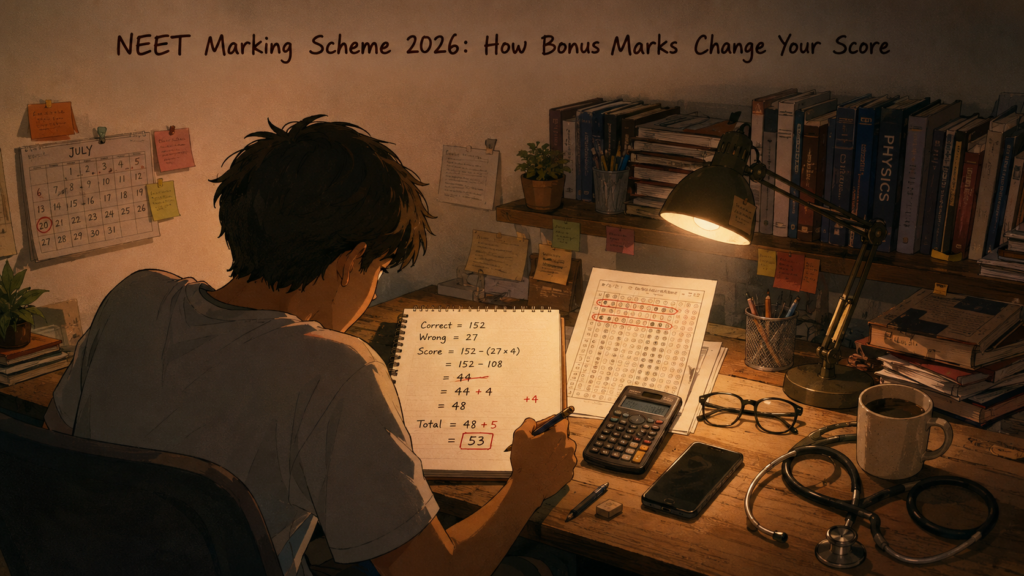
| Got dropped wrong, marked wrong in two-answer | +5 added (remove −1 + add +4) | No change | +5 to estimate |
| Got dropped wrong, left two-answer blank | +5 added | No change | +5 to estimate |
The maximum bonus impact: A student who counted the dropped question as wrong and had no attempt on the two-answer question gains up to +5 marks compared to their initial estimate. At competitive cutoff bands, 5 marks can shift rank by hundreds of positions.
Why This Matters More Than Most Students Realise?
The bonus marks in NEET 2026 from these two Physics questions affect every single student, but not equally. Students who:
- Initially counted the dropped question as wrong → gain the most (+5 adjustment)
- Left the dropped question blank → gain +4
- Were already counting the dropped question as correct → gain nothing new
At the cutoff boundary, where 1–2 marks separate students who qualify for government MBBS from those who don’t, a 4 or 5-mark bonus can be the difference between getting a government seat and not. This isn’t a minor technical detail. For students near the cutoff, it’s one of the most important numbers in their result.
What Happens in the Final Answer Key
The NEET 2026 bonus marking scheme adjustments are reflected in the final answer key, not the provisional one. The final answer key, expected around July 10–20, 2026 or alongside the result, will incorporate all accepted objections and officially document the dropped question and two-answer question handling. Students cannot challenge the final answer key. Once it’s published, it’s the authoritative document used exclusively for computing every student’s NEET 2026 result.
The sequence:
- Provisional answer key (released June 25), used for initial score estimation
- Objection review, NTA experts reviewed 10,000+ challenges
- Final answer key (expected July 10–20), incorporates all corrections including bonus marks
- Result (expected July 20), calculated solely on final answer key
Marking scheme understood. Here’s how to apply it to your full paper and get your estimated score: NTA NEET Answer Key 2026: Score Calculator, Marking Scheme & Objection Process
Check official NEET 2026 final answer key and result at neet.nta.nic.in
Author
