
Clearing NEET UG 2026 is a massive milestone. It is also, brutally, only half the war. The real competition begins during NEET UG counselling 2026, where your All India Rank gets converted; through a maze of choice filling, document checks, and round-by-round seat allotment into an actual medical college admission. Here’s the part nobody warns you about loudly enough: many students lose seats due to avoidable errors, not low scores. Read that again. Not low scores. Avoidable errors. Students with genuinely strong ranks walk away with nothing or with a far worse seat than they deserved; because of a mistake in the counselling process itself, not the exam. This guide exists; so, that doesn’t become your story.
Mistake 1: Treating “Qualified” Like the Finish Line
This is where the damage usually starts. A student clears NEET, celebrates, and quietly assumes the hard part is over. It isn’t. The counselling procedure is completely online and follows a strict schedule, with its own deadlines, its own documents, its own traps; and missing any one of them can undo months of preparation in a single careless afternoon.
The fix: Treat counselling as a second exam, one with deadlines instead of questions, and paperwork instead of formulas. Prepare for it with the same seriousness you brought to NEET itself.
Mistake 2: Confusing AIQ and State Quota
Here’s a distinction that trips up thousands of students every single year. NEET medical seats split into two separate systems. The All India Quota (AIQ) covers 15% of government seats, run by the Medical Counselling Committee (MCC) at mcc.nic.in, open to students from any state. The State Quota covers the remaining 85%, run by each state’s own counselling authority, with eligibility tied to domicile. These are not one process with two names. They are two entirely separate registrations, two separate choice-filling systems, and two separate deadlines.
| Category | AIQ (15% seats) | State Quota (85% seats) |
| Run by | MCC (mcc.nic.in) | State authorities |
| Open to | All India students | State domicile only |
| Rank used | All India Rank | State rank/merit list |
The fix: Register for both, separately, on time. Treat them as two campaigns running in parallel, not one process you’ll “get to eventually.”
Mistake 3: Filling Too Few Choices
This is the single most repeated mistake across every counselling guide, every coaching institute, every year, because students keep making it anyway. Always include multiple college options, not just top institutes. Research colleges thoroughly, understand fees, infrastructure, and ranking before selecting; but don’t let that research talk you into a list of five aspirational colleges and nothing else. More choices increase chances of allotment. There is no limit for entry of options, and candidates are encouraged to enter more options to avoid disappointment of not getting allotment. A short, dream-only list isn’t ambition. It’s a gamble with your entire admission year.
The fix: Fill choices in tiers, a few aspirational, several realistic, a handful of safety options. Order them by genuine preference, not by what sounds most impressive to relatives.
Mistake 4: Not Locking Choices Before the Deadline
Lock your choices before the deadline. This step is crucial as it finalizes your preferences. Skip it, and the system may auto-lock your choices for you, which can sometimes disrupt your strategy entirely, freezing an incomplete or poorly-ordered list as your final word.
The fix: Don’t wait until the last hour to lock. Servers slow down, portals crash, and “I’ll do it tonight” has cost more seats than any single academic mistake on this list.
Mistake 5: Showing Up With the Wrong Documents
Missing or incorrect documents can lead to seat cancellation, even after allotment. Even if you secure a good rank, missing or incorrect documents can lead to cancellation of your MBBS seat. One missing paper can wipe out your medical seat in seconds. The single most damaging version of this mistake: a name or date of birth mismatch across documents, a different spelling on the Aadhaar card versus the Class 10 certificate, for instance. It sounds trivial. It is not. Verification officials treat it as a red flag, not a typo.
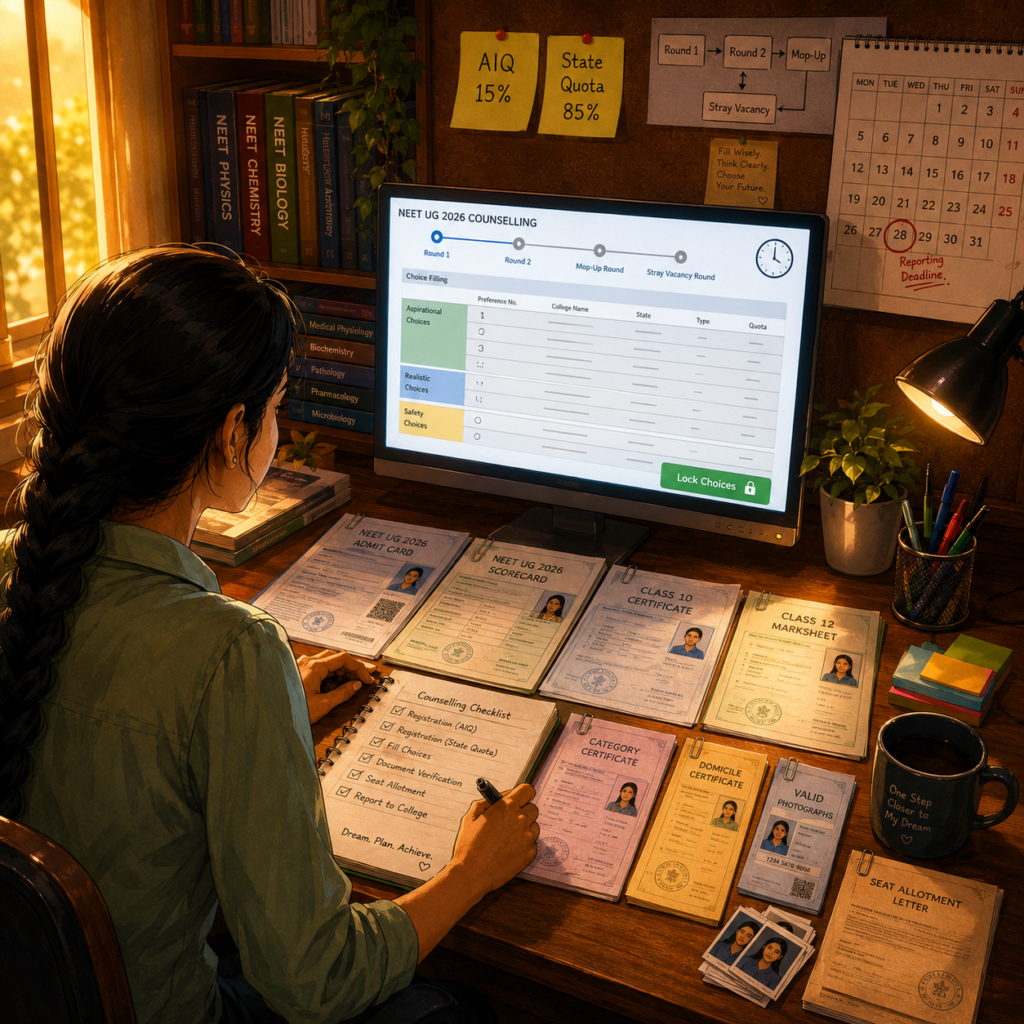
Core documents required for NEET counselling:
| Document | Why It Matters |
| NEET UG 2026 Admit Card | Identity and exam proof |
| NEET UG 2026 Scorecard | Confirms rank and eligibility |
| Class 10 Certificate | Date of birth proof |
| Class 12 Marksheet | Subject and eligibility proof |
| Category Certificate (if applicable) | Reservation claim verification |
| Domicile Certificate | Mandatory for claiming the 85% state quota |
| Valid Photo ID | Identity confirmation |
| Passport-size Photographs | Same specifications as NEET application |
| Seat Allotment Letter | Proof of allocation for reporting |
The fix: Carry every original document. Carry two to three self-attested photocopies of each. Match every single detail across every single paper; name spelling, date format, everything. Most students spend months preparing for NEET but only a few days preparing their documents for counselling. Reverse that ratio.
Mistake 6: Misunderstanding How Many Seats Actually Exist
Students often walk into counselling with an inflated sense of how much room there really is; and that misunderstanding shapes bad choice-filling decisions. Medical admissions in India happen through NEET UG across MBBS, BDS, and AYUSH courses combined. The 15% AIQ category alone spans MBBS and BDS seats across states, 100% of AIIMS seats nationwide, 100% of JIPMER seats, and 100% of BHU and AMU seats; a meaningful chunk of the country’s most coveted institutions, but still a small slice of the overall seat pool.
The fix: Understand that total seats in NEET span far more than just the colleges you’ve heard of. State quota alone, the 85% majority opens doors at institutions most students never research because they’re too busy refreshing rankings for the same twenty famous names.
Mistake 7: Giving Up After One Round
If not satisfied, you may opt for the next round, depending on the rules. Yet every year, students who don’t get their preferred seat in Round 1 spiral into the assumption that it’s over. It isn’t. Counselling runs across multiple rounds and seats genuinely shift as students upgrade, drop out, or fail to report. The Stray Vacancy Round in particular often opens doors that weren’t visible in earlier rounds, simply because seats that initially looked locked become available again.
The fix: Stay registered. Stay active. A single disappointing round is information, not a verdict.
Mistake 8: Ignoring the Reporting Deadline After Allotment
Getting allotted a seat is not the same as having a seat. After allotment, candidates must report to the college for document verification and fee payment within a strict window and missing it can cancel the allotment entirely, sending the seat right back into the pool for someone else.
The fix: The moment a seat is allotted, treat the reporting deadline as non-negotiable. Travel arrangements, fee payment, and document verification should all be planned in advance, not scrambled together after the result drops.
The Pattern Behind Every Mistake on This List
Look closely at all eight mistakes above, and one thing becomes obvious, none of them are about intelligence, and none of them are about NEET preparation. Every single one is about attention, timing, and respect for a process that genuinely does not forgive carelessness. The counselling procedure is not difficult, but it requires awareness, strategy, and timely action. Students who treat it that way; methodically, seriously, with documents ready before they’re asked for and choices filled before the deadline looms, consistently land better seats than students with marginally higher ranks who treat counselling as an afterthought.
Success in NEET is only half the journey. The right counselling strategy completes it.
Filling choices blindly is mistake number one. Know your rank first: NEET Marks vs Rank 2026: Expected AIR, Cutoff & Which Medical College You Can Get
Check official AIQ counselling details at mcc.nic.in
Author
