
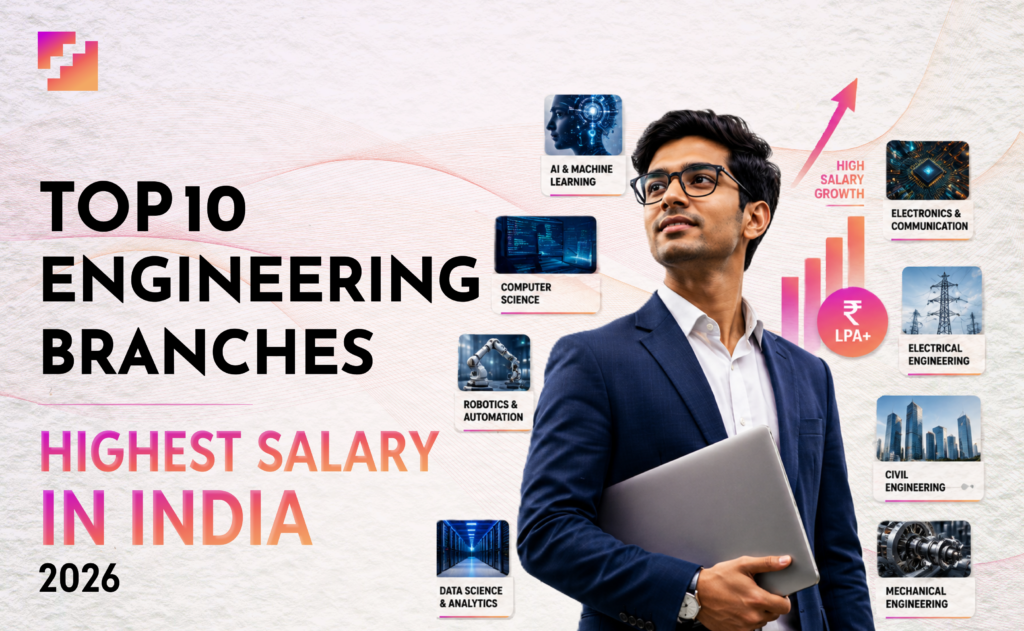
Two engineers from the same college and the same batch year can start completely different careers. One may begin at ₹8 LPA, while the other walks out with ₹35 LPA and the difference is not luck, but the branch they chose and the specialisation they built. That is why the Highest Paying Engineering Branches In India matter more than ever in 2026. Salary now depends on your branch, your skills, and the company type, making branch choice one of the most important decisions in an engineering career.
Why Branch Selection Matters More Than Ever in 2026
According to NASSCOM, India will need over 1 million AI professionals by 2026, and the talent gap is already visible in hiring numbers. The India Semiconductor Mission has approved ₹1.6 lakh crore in chip manufacturing investment, creating thousands of VLSI roles that barely existed five years ago. India’s EV revolution is rewarding Mechanical engineers who specialize; while leaving generalists behind.
At the same time, the gap between service company and product company salaries has never been wider. A CSE fresher at TCS or Infosys earns ₹6–10 LPA. The same graduate at Amazon, Microsoft, or Razor pay earns ₹20–40 LPA. Same degree. Different company type. The ₹10–15 lakh difference comes from DSA preparation, competitive programming, and a strong portfolio; not the branch name on the degree.
Key insight for students: Your branch is your floor. Your specialisation and skills determine your ceiling.
Top 10 Engineering Branches with Highest Salary in India (2026)
Here are the top 10 engineering branches ranked by salary potential; fresher to senior level — for Indian students and graduates in 2026.
1. AI & Machine Learning Engineering — ₹18–28 LPA (Fresher)
| Category | Salary Range |
|---|---|
| Median Fresher Salary (Product Companies) | ₹18–28 LPA |
| Senior / Mid-Level | ₹40–80 LPA+ |
| Highest Package (IIT) | ₹1 Crore+ |
| Job Growth | 67%+ |
AI and Machine Learning Engineering is the single highest-paying engineering branch in India right now; and it is not particularly close.
According to NASSCOM, AI-related job demand in India is expected to cross one million roles by 2026, growing at over 67%. Only about 16% of IT professionals are currently AI-skilled. That gap is what keeps salaries high and forces companies to compete aggressively for qualified candidates.
A fresher who joins a product company like Google, Amazon, Zepto, or PhonePe earns ₹18–28 LPA from day one. Spend five years building at those companies and ₹40 LPA is where negotiation starts; not where it ends. Specialized AI roles at IITs have crossed ₹1 crore in placement offers.
Skills that matter most: Python, PyTorch, TensorFlow, and; critically, at least two real deployed projects. Your degree gets you in the room. What you have actually shipped gets you the offer.
Top Recruiters: Google, Amazon, Microsoft, Zepto, PhonePe, TCS iON, Infosys AI Division
2. Computer Science Engineering (CSE) — ₹6–40 LPA (Fresher)
| Category | Salary Range |
|---|---|
| Fresher Salary (Service Companies) | ₹6–10 LPA |
| Fresher Salary (Product Companies) | ₹20–40 LPA |
| Highest Package (IIT) | ₹2 Crore+ |
| Job Growth | 25%+ |
CSE remains the most in-demand and highest-placed engineering branch in India. The enormous spread in fresher salaries; ₹6 LPA to ₹40 LPA; comes entirely from the type of company, not the quality of the degree.
At service companies (TCS, Infosys, Wipro), CSE freshers start at ₹6–10 LPA. At product companies (Microsoft, Razorpay, CRED, Amazon), the same graduate earns ₹20–40 LPA. IIT Bombay, Delhi, and Madras CSE graduates average ₹25–40 LPA in placements, with the highest packages exceeding ₹2 crore for specialised AI and systems roles.
The key differentiator is preparation: DSA (Data Structures and Algorithms), system design, and competitive programming. Students who invest in product-company interview preparation consistently land offers ₹10–15 lakh higher than peers who do not.
Add AI/ML specialization within CSE and those numbers climb further; making this the safest high-salary path for the broadest range of students.
Top Recruiters: Microsoft, Amazon, Razorpay, CRED, Flipkart, Google, TCS (product division), Swiggy
3. Data Science & Data Engineering — ₹7–18 LPA (Fresher)
| Category | Salary Range |
|---|---|
| Fresher Salary | ₹7–18 LPA |
| Senior Data Engineer (Product Firm) | ₹50 LPA+ |
| Key Industries | Banking, E-commerce, Healthcare, Logistics, Agriculture |
Every company with over a thousand customers needs someone to make sense of their data. Data science stopped being a tech-sector-only career several years ago; banking, e-commerce, healthcare, logistics, and even agriculture now hire data professionals actively.
Starting as a data scientist, freshers can expect ₹7–18 LPA depending on the employer. Move into a senior data engineering role at a product firm and ₹50 LPA is very much on the table.
What matters most in interviews: Python (Pandas, NumPy), at least one BI tool (Power BI or Tableau), and a Kaggle competition ranking. A Kaggle profile does more for your resume than most certifications; recruiters at Flipkart, IBM, and Deloitte actively check it.
Top Recruiters: Flipkart, IBM, Deloitte, Swiggy, Mu Sigma, Tiger Analytics, Accenture Analytics
4. Cybersecurity Engineering — ₹8–15 LPA (Fresher)
| Category | Salary Range |
|---|---|
| Fresher Salary | ₹8–15 LPA |
| Senior / Ethical Hacking Roles | ₹25–50 LPA |
| India Talent Shortage | 8 Lakh professionals |
India recorded over 1.59 million cybersecurity incidents in 2023 alone, according to CERT-In, with financial institutions becoming the most targeted sector. The World Economic Forum estimates India faces a shortage of 8 lakh cybersecurity professionals; a gap that is widening every year and pushing salaries upward faster than most engineering branches.
A CEH (Certified Ethical Hacker) or CompTIA Security+ certification at the fresher level earns ₹8–15 LPA straight out of college. Adding cloud security expertise (AWS Security Specialty) or ethical hacking skills pushes packages past ₹25 LPA. Senior security architects at firms like Palo Alto Networks and IBM earn ₹40–50 LPA and above.
This is one of the most underrated top engineering branches for future scope in India. Demand is structural, competition is relatively low compared to CSE, and the talent gap means salaries will keep rising.
Top Recruiters: Palo Alto Networks, IBM, Cisco, EY, KPMG, Wipro CyberSecurity, Deloitte
5. ECE / VLSI & Semiconductor Engineering — ₹12–30 LPA (Specialist)
| Category | Salary Range |
|---|---|
| General ECE Fresher Salary | ₹4–8 LPA |
| VLSI Specialist Fresher Salary | ₹12–30 LPA |
| India Semiconductor Mission Investment | ₹1.60 Lakh Crore |
Electronics and Communication Engineering (ECE) does not always grab headlines the way CSE does. But it sits at the intersection of hardware and software; making its graduates genuinely versatile across semiconductors, telecom, defense electronics, and IoT.
India’s Semiconductor Mission has approved 10 projects with a combined investment of ₹1.60 lakh crore across six states. Companies like Qualcomm, Intel, Samsung, and Texas Instruments are expanding R&D operations in India alongside domestic chip manufacturers. This investment needs VLSI engineers; and most ECE graduates do not have VLSI skills, which is exactly why the ones who do get the offers first.
VLSI chip design specialists using tools like Cadence or Synopsys earn ₹12–30 LPA at entry level; salaries that now rival top-tier CSE product company packages. ECE graduates at IITs average ₹18–25 LPA in placements.
Top Recruiters: Qualcomm, Intel, Samsung, Texas Instruments, MediaTek, NXP Semiconductors, ARM India
6. Cloud & DevOps Engineering — ₹8–25 LPA (Fresher to Mid-Level)
| Category | Salary Range |
|---|---|
| Fresher Salary | ₹8–12 LPA |
| AWS Certified Premium | +20–30% above base pay |
| Market Adoption | 90% of businesses expected on cloud by 2030 |
Pick any mid-to-large company in India. Their infrastructure runs on AWS, Azure, or Google Cloud. CI/CD pipelines, Kubernetes, and cloud architecture are skills that translate immediately into higher starting offers.
The AWS Solutions Architect Associate certification is one of the few credentials that actually moves your starting salary on day one; up to 20–30% above a non-certified peer. Recruiters know it means you can deploy and manage real infrastructure, not just talk about it.
Cloud and DevOps engineers earn ₹8–25 LPA depending on certification level and company size. This is one of the most accessible high-salary paths for CSE and IT graduates who invest in the right certifications before graduation.
Top Recruiters: Amazon AWS, Microsoft Azure, Accenture, Capgemini, HCLTech, Cognizant, Infosys Cloud
7. Aerospace Engineering — ₹8–25 LPA
| Category | Salary Range |
|---|---|
| ISRO / HAL Fresher | ₹8–15 LPA + benefits |
| Private Aerospace Firms | ₹12–25 LPA |
| Senior R&D Roles | ₹25 LPA+ |
Five years ago, Aerospace Engineering in India meant ISRO, HAL, and not much else. Today, Skyroot Aerospace, Agnikul Cosmos, and a wave of defence-tech startups have created job titles that did not exist in 2020. Space technology as a career in India has never had more entry points.
ISRO and HAL start freshers at ₹8–15 LPA with solid job security and benefits packages. Private aerospace firms pay more for R&D roles. Senior positions at both types of organisations sit at ₹25 LPA and above, with the ceiling growing as India’s space economy expands rapidly.
For students who are passionate about aerospace and are willing to put in the work for competitive government recruitment, this is one of the most rewarding and prestigious engineering branches available.
Top Recruiters: ISRO, HAL, DRDO, Skyroot Aerospace, Agnikul Cosmos, Boeing India, Safran India
8. Mechanical Engineering (EV & Robotics Specialisation) — ₹4–24 LPA
| Category | Salary Range |
|---|---|
| General ME Fresher | ₹4–6 LPA |
| EV / Robotics Specialist | ₹10–24 LPA |
| PSU via GATE (ONGC, BHEL) | ₹12–18 LPA |
Mechanical Engineering’s salary in India depends almost entirely on your specialization. A general Mechanical Engineering graduate earns ₹4–6 LPA; that is the honest number. But a Mechanical engineer who specializes in electric vehicle systems or robotics earns ₹10–24 LPA at companies like Tata Motors, Mahindra, GreyOrange, and Hyundai India.
India’s EV revolution is creating structural demand for Mechanical engineers who understand battery systems, drivetrain design, and automation. Royal Enfield, Hyundai, and John Deere actively recruit for EV and automation roles from engineering campuses.
Mechanical graduates who clear GATE can secure PSU positions at ONGC, BHEL, and NTPC with starting salaries of ₹12–18 LPA; plus exceptional benefits, housing allowances, and long-term job security that most private-sector offers cannot match.
Top Recruiters: Tata Motors, Mahindra EV, ONGC, BHEL, GreyOrange, Royal Enfield, Hyundai India
9. Biomedical Engineering — ₹6–12 LPA (Fresher)
| Category | Salary Range |
|---|---|
| Fresher Salary | ₹6–12 LPA |
| Senior R&D Roles | ₹20 LPA+ |
| India Average (Experienced) | ₹11–21 LPA |
Your hospital visit today involves more software than most people realize; imaging systems, monitoring devices, diagnostic platforms, and clinical data pipelines. GE HealthCare, Medtronic, and Siemens Healthineers hire biomedical engineers specifically for roles that sit at the intersection of clinical systems and software engineering.
Biomedical Engineering is a quieter field than CSE or AI; which means competition for good roles is lower than most students expect. Fresher salaries range from ₹6–12 LPA. Senior biomedical engineers in R&D roles earn ₹20 LPA and above.
With India’s digital health push, the wearable technology boom, and increasing healthcare digitisation, this is one of the top engineering branches for future scope; particularly for students who want meaningful, mission-driven work alongside competitive compensation.
Top Recruiters: GE HealthCare, Medtronic, Siemens Healthineers, Philips India, Niramai, Qure.ai
10. Petroleum Engineering — ₹12–18 LPA (PSU via GATE)
| Category | Salary Range |
|---|---|
| PSU Fresher (via GATE) | ₹12–18 LPA + allowances |
| Senior Level | ₹25 LPA+ |
| Competition Level | Very Low |
Clear GATE. Get into ONGC, IOCL, or Shell India. Your day-one salary is ₹12–18 LPA; before field allowances, housing, and benefits are counted. Most private-sector offers stop looking attractive once the full PSU compensation package is on the table.
Fewer students choose Petroleum Engineering compared to tech branches, which means fewer candidates competing for available roles. While job volume is limited, the combination of salary, PSU stability, lifetime benefits, and pension makes this one of the most rewarding career paths for the right student; particularly those comfortable with postings outside metro cities.
Top Recruiters: ONGC, IOCL, BPCL, Shell India, Cairn Energy, Halliburton India
Engineering Branch Salary Comparison — India 2026
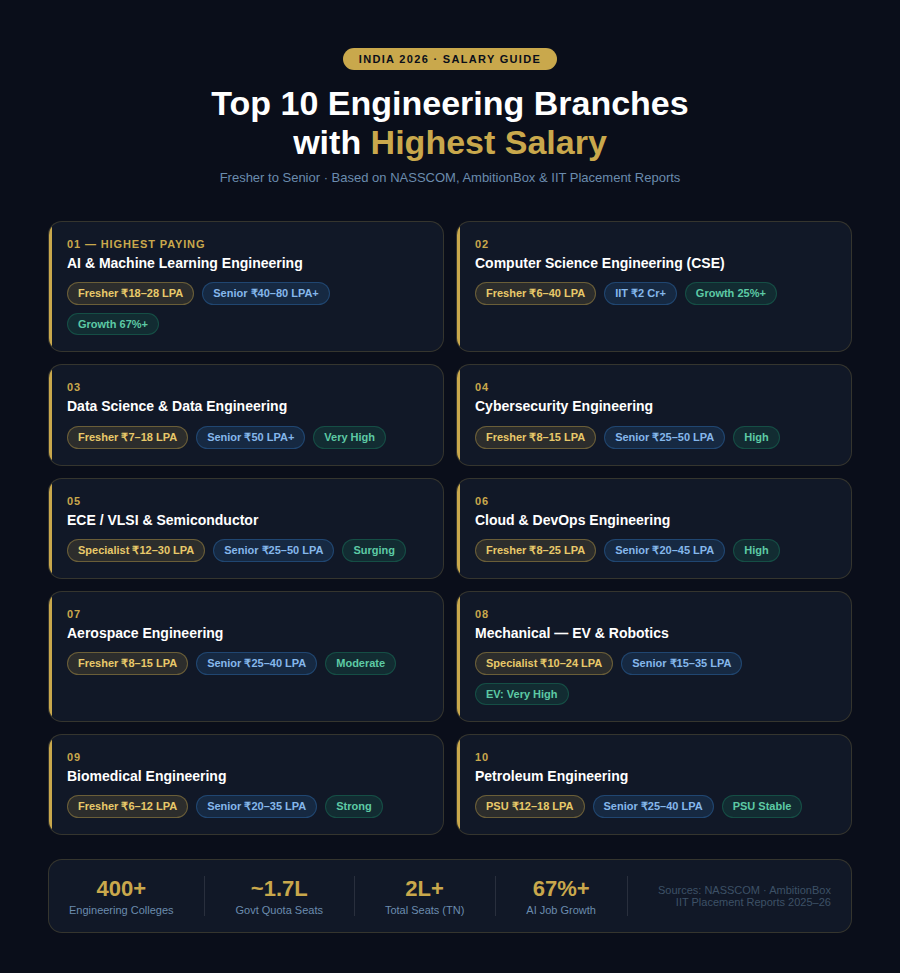
| # | Engineering Branch | Fresher Salary (₹ LPA) | Senior Salary (₹ LPA) | Job Growth | Best For |
|---|---|---|---|---|---|
| 1 | AI & ML Engineering | ₹18–28 | ₹40–80+ | 67%+ | Tech / Startups |
| 2 | CSE / Software Engineering | ₹6–40 | ₹50–2Cr+ | 25%+ | Product Companies |
| 3 | Data Science & Engineering | ₹7–18 | ₹30–50+ | Very High | Analytics / BI |
| 4 | Cybersecurity Engineering | ₹8–15 | ₹25–50+ | High | Banking / Fintech |
| 5 | ECE / VLSI (Semiconductor) | ₹12–30 | ₹25–50 | Surging | Chip Design |
| 6 | Cloud & DevOps Engineering | ₹8–25 | ₹20–45 | High | IT / Cloud |
| 7 | Aerospace Engineering | ₹8–15 | ₹25–40 | Moderate | ISRO / Defence |
| 8 | Mechanical (EV / Robotics) | ₹4–24 | ₹15–35 | EV: Very High | Auto / Manufacturing |
| 9 | Biomedical Engineering | ₹6–12 | ₹20–35 | Strong | HealthTech / R&D |
| 10 | Petroleum Engineering | ₹12–18 | ₹25–40 | Limited (PSU) | ONGC / IOCL |
Sources: https://nasscom.in, AmbitionBox, Glassdoor India, Payscale India, IIT Placement Reports 2025–2026.
Top Engineering Branches for India’s Future (2026–2035)
Salary today and salary five years from now are not the same question. Here are the branches that offer the strongest combination of current pay, long-term growth, and India-specific demand over the next decade:
1. AI & ML Engineering — India needs 1 million AI professionals by 2026. The talent gap means salaries will keep rising faster than supply for at least a decade. Every sector — from healthcare to agriculture to finance — is actively hiring AI engineers.
2. CSE with Specialisation — The safest high-salary path, especially for product-company aspirants. Adding AI/ML, Cloud, or Cybersecurity specialisation within CSE multiplies earning potential dramatically.
3. VLSI / Semiconductor Engineering — India’s ₹1.6 lakh crore Semiconductor Mission is creating thousands of high-paying chip design jobs. This is a structural, government-backed demand surge that will sustain for 10+ years.
4. Mechanical — EV & Robotics Track — India’s EV revolution and manufacturing automation push are creating a new high-paying tier within an otherwise moderate-salary branch. Specialise in EV or automation and your branch ceiling rises sharply.
5. Biomedical Engineering — Digital health, wearables, and precision medicine are driving consistent multi-decade demand. Competition is lower than tech branches, making it easier to stand out.
Highest paying engineering branches in India? FAQs
Q: Which engineering branch has the highest salary in India in 2026?
A: AI and Machine Learning Engineering offers the highest fresher salary; ₹18–28 LPA at product companies, with IIT packages exceeding ₹1 crore for specialized AI roles. For non-IIT graduates, CSE at product companies and VLSI engineering are the top earners.
Q: Is CSE still the best engineering branch in India?
A: Yes. CSE offers the widest salary range, the highest job volume, and the most flexible career paths. The key is targeting product companies over service companies through strong DSA and system design preparation.
Q: What is the difference between service company and product company salaries?
A: At a service company (TCS, Infosys, Wipro), a CSE fresher earns ₹6–10 LPA. At a product company (Microsoft, Amazon, Razorpay), the same degree earns ₹20–40 LPA. The gap comes from company-specific interview preparation; not the branch or degree itself.
Q: Which engineering branch is best for government jobs in India?
A: For PSU government jobs via GATE, Mechanical, Electrical, Chemical, and Petroleum Engineering are the strongest paths. Top PSUs include ONGC, BHEL, NTPC, IOCL, and GAIL. Starting PSU salaries range from ₹12–18 LPA with exceptional benefits and job security.
Q: Is ECE a good branch in 2026?
A: Yes; especially for students who specialize in VLSI and semiconductor design. With India’s Semiconductor Mission driving ₹1.6 lakh crore in chip manufacturing investment and global companies like Qualcomm and Intel expanding in India, ECE (VLSI) now offers packages that rival top CSE roles.
Q: Which engineering branch has the best future scope in India?
A: AI & ML Engineering, CSE with cloud/cybersecurity specialisation, VLSI/Semiconductor Engineering, Mechanical (EV track), and Biomedical Engineering all have strong long-term outlooks driven by structural, India-specific demand factors.
Final Thoughts: Branch Matters, But Skills Decide Your Salary
The most important insight from this data is simple: your engineering branch sets your starting floor, but your specialisation and skills build your ceiling.
A Mechanical engineer who learns Python for EV simulation earns 2× more than one who doesn’t. An ECE graduate who masters VLSI tools earns as much as a mid-tier CSE graduate at a product company. A CSE student with a strong GitHub portfolio and solid DSA preparation earns ₹15–20 LPA more than a batchmate from the same college who doesn’t.
In 2026, companies hire based on proof of work; a GitHub repository, a Kaggle ranking, a deployed project, a strong competitive programming profile. Your branch gets you the interview. Your skills and portfolio get you the offer.
Choose the branch that aligns with your interests, prepare with the seriousness the market demands, and specialize in the area where India’s structural demand is growing. That combination; more than any single branch name; is what determines where your engineering career goes.
Author
