
Choosing between government vs private engineering colleges is the same dilemma every TNEA aspirant eventually faces: chase a seat at a top government college with a moderate cutoff, or accept a private college that guarantees admission in your preferred branch. Therefore, this comparison breaks down fees, faculty quality, placements, and infrastructure across both college types, so you can make the choice that actually suits your priorities, not just your rank.
Table of Contents
-> Government vs private colleges: quick overview
-> The fee gap between government and private colleges
-> Faculty and academics: private vs government colleges
-> Which places better, private or government colleges
-> Campus and facilities across government and private colleges
-> Government vs private colleges: how to decide for TNEA 2026
Government vs private colleges: quick overview
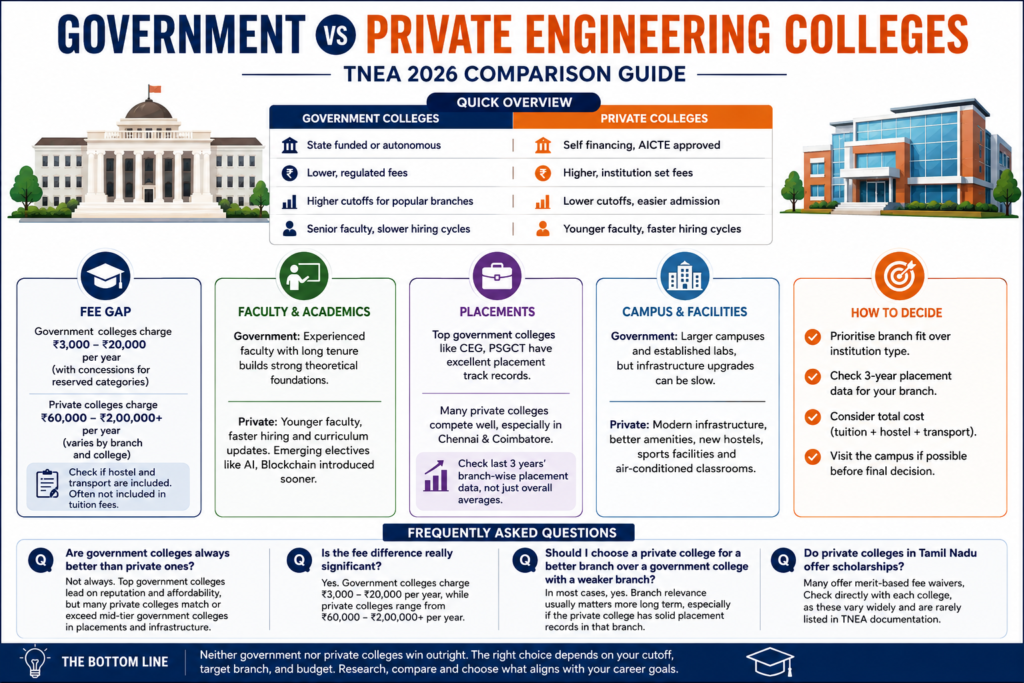
Government colleges in Tamil Nadu run directly under state funding, or as autonomous institutions like Anna University constituent colleges. Private colleges, in contrast, operate as self financing institutions approved by AICTE and affiliated to Anna University. This funding source is the real divide behind government vs private engineering colleges, shaping fees, faculty stability, and how fast infrastructure gets upgraded.
| Government colleges | Private colleges |
| State funded or autonomous | Self financing, AICTE approved |
| Lower, regulated fees | Higher, institution set fees |
| Higher cutoffs for popular branches | Lower cutoffs, easier admission |
| Senior faculty, slower hiring cycles | Younger faculty, faster hiring cycles |
The fee gap between government and private colleges
Fee structure remains the single biggest difference between the two college types. Government and government aided colleges follow a fee structure regulated by the state. This keeps annual costs significantly lower than private institutions.
What government colleges typically charge
Tuition fees at government engineering colleges usually range from a few thousand rupees to around twenty thousand rupees annually for general category students. Reserved category students get further fee concessions.
What private colleges typically charge
Private self financing colleges set their own fees. These commonly range from sixty thousand to over two lakh rupees per year, depending on the institution’s reputation and the branch chosen. Computer science and related branches usually command the highest fees.
Always check whether a private college’s quoted fee includes hostel and transport separately. The advertised tuition fee often excludes these costs entirely.
Faculty and academics: private vs government colleges
Government colleges generally retain faculty for longer periods. This builds institutional depth in research and teaching experience over decades. The stability often translates into stronger theoretical grounding and deep subject expertise.
Private colleges, in contrast, tend to hire younger faculty more aggressively and update their curriculum faster. They are not bound by the same procurement cycles that government institutions follow. This means private colleges sometimes introduce emerging electives, like AI or blockchain, faster than older government institutions.
Which places better, private or government colleges
Top government colleges like College of Engineering Guindy and PSG College of Technology consistently post some of the highest placement percentages in the state. Decades of brand reputation among recruiters drive this strong record.
Where private colleges compete well
However, several private colleges post placement numbers that rival mid tier government colleges. This holds especially true for colleges with strong industry ties near Chennai and Coimbatore. Therefore, branch and college specific placement data matters far more than the broad government versus private label.
Always check the previous three years of placement reports for your specific branch at any college you shortlist. The institution’s overall average can mask weak performance in less popular branches.
Campus and facilities across government and private colleges
Older government colleges often carry the advantage of larger campuses and established laboratories built over many decades. However, renovation can move slowly due to bureaucratic approval processes.
Newer private colleges frequently invest heavily in modern infrastructure, including newer hostels, sports facilities, and air conditioned classrooms. Competing on amenities helps them stand out in a crowded market.
Government vs private engineering colleges — how to decide for TNEA 2026
If your cutoff comfortably secures a strong branch at a respected government college, that option usually wins on cost alone. This holds true if the branch itself interests you. However, if your cutoff only qualifies you for a weak branch, a strong branch at a well regarded private college often serves your career better than an unwanted government seat.
- Prioritise branch fit over institution type whenever your cutoff forces a trade off
- Check three year placement data for your specific branch, not just the college average
- Factor in total cost, including hostel and transport, not just tuition fees
- Visit the campus if possible before finalising your choice during counselling
Frequently asked questions
Not always. Top government colleges generally lead on reputation and affordability. However, several private colleges match or exceed mid tier government colleges in placements and infrastructure for specific branches.
Yes. Government colleges typically charge a few thousand to twenty thousand rupees annually. Private colleges range from sixty thousand to over two lakh rupees per year, making the gap substantial over four years.
In most cases, yes. Branch relevance to your career goals usually matters more long term than the government versus private label. This holds especially true if the private college has solid placement records in that branch.
Many private colleges offer merit based fee waivers for high scoring students. Check directly with each shortlisted college, since these programmes vary widely and rarely appear in official TNEA documentation.
The bottom line
Neither government nor private colleges win this comparison outright. The right choice depends entirely on your cutoff, target branch, and budget. Therefore, research branch specific placement data, calculate total costs honestly, and choose the option that aligns with your actual career goals rather than a general reputation alone.
Author
