
India has 1.5 million schools, 250 million students, and a shortage of nearly one million teachers. And yet, the conversation around AI in education in India keeps circling the same narrow question, is ChatGPT making students lazy? That is the wrong debate, and it is the debate, India cannot afford to keep having in 2026. The real question is bigger, more urgent, and far more exciting, can AI in education finally reach every classroom in this country, including the ones that have been left behind for decades?
AI in Education in India: Where We Are in 2026
The Government of India has announced plans to integrate AI into teaching and learning across all education levels from the 2026–27 academic year. Starting from Grade 3, AI will be introduced as part of the curriculum aligned with the National Education Policy 2020 and the National Curriculum Framework for School Education 2023.
Additionally, the Ministry of Education concluded the Bharat Bodhan AI Conclave 2026 in New Delhi, bringing together policymakers, state governments, researchers, and EdTech innovators to examine how AI can transform school education; particularly foundational literacy, numeracy, teacher effectiveness, and multilingual inclusion.
Furthermore, states like Haryana have already begun rolling out AI courses in government schools from March 2026, starting with Class IX students.
The policy intent is clear. However, the gap between intent and classroom reality remains enormous, especially for the millions of students in government schools across rural and semi-urban India.
Related Read: Best Engineering College or Not? Here Is How to Find Out ~ how technology and education decisions shape careers.
The Debate India Keeps Missing About AI in Education
When parents and educators talk about AI in education for students, the conversation almost always defaults to fear. Will AI replace teachers? Will students stop thinking for themselves? Is this generation becoming intellectually dependent on technology?
These are valid concerns. However, they are the concerns of a relatively small, urban, English-speaking population that already has access to quality education.
For the majority of India’s students; sitting in under-resourced government schools, taught by overworked teachers managing classrooms of 50 or more, without access to coaching centres or private tutors, the question is entirely different.
For them, the question is not whether AI is too much. It is whether AI in education 2026 will ever reach them at all.
As the Ernst & Young–Parthenon report noted, AI in education is driving changes like personalised teaching, multilingual learning, and real-time assessments, and 2025–26 is being called an inflexion point for Indian education. The infrastructure is being built. But access remains deeply unequal.
What AI Personalised Learning Can Actually Do for Indian Students
The most powerful application of AI in education is also the most misunderstood one, personalised learning.
Traditional classroom instruction is designed around an average student. A teacher sets a pace, a level of complexity, and a sequence of topics that works reasonably well for the middle of the class, but consistently leaves both struggling and advanced students underserved.
AI personalised learning in India changes this equation fundamentally.
An AI-powered adaptive learning system continuously monitors a student’s progress time spent on a topic, quiz scores, areas of repeated difficulty and adjusts the difficulty level, explanation style, and pace accordingly. A student in Class 7 who struggles with fractions gets a different learning path from a classmate who has already mastered the concept. Both students sit in the same classroom. However, both now have a learning experience built specifically for them.
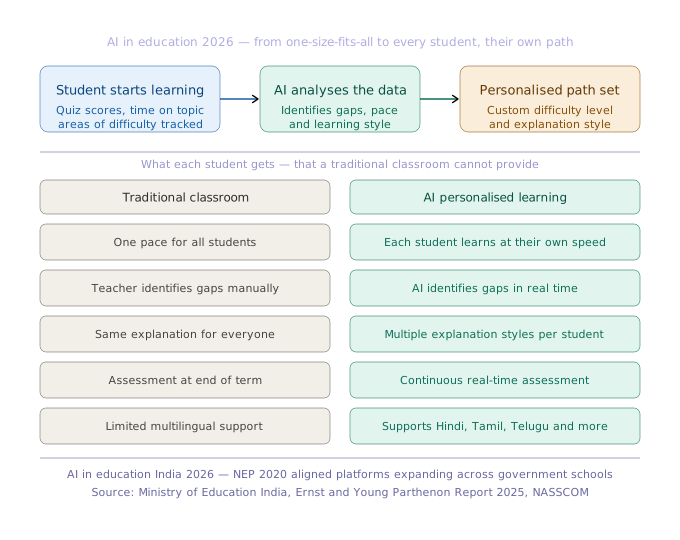
| Traditional Classroom | AI-Powered Personalised Learning |
| One pace for all students | Each student learns at their own speed |
| Teacher identifies gaps manually | AI identifies gaps in real time |
| Same explanation for everyone | Multiple explanation styles per student |
| Limited multilingual support | AI supports regional languages |
| Assessment at end of term | Continuous, real-time assessment |
This is not a distant possibility. Platforms aligned with NEP 2020 are already delivering this kind of adaptive learning across India, and the results in early pilots have been measurable.
AI in Education Equity: The Classroom That Gets Left Behind
Here is the uncomfortable truth at the centre of the AI in education debate in India.
The students who need AI the most are the ones least likely to have access to it.
Private school students in Chennai, Mumbai, or Bengaluru are already using AI tutors, smart learning apps, and adaptive platforms as part of their daily study routine. Meanwhile, a student in a government school in rural Bihar or eastern Uttar Pradesh may not have reliable electricity, let alone a device capable of running an AI learning platform.
This is the AI in education equity problem, and it is the conversation India is not having loudly enough.
Consider the scale: India has 1.5 million schools. The majority are government schools. Of those, a significant number still lack basic digital infrastructure; computers, internet connectivity, or even consistent power supply. Introducing AI in education without solving this foundational gap does not bridge the divide. It widens it.
| Challenge | Scale in India |
| Government schools without computers | Significant percentage, especially rural |
| Teacher shortage | Approximately 1 million unfilled positions |
| Students without device access at home | Hundreds of millions |
| Schools without reliable internet | Majority in Tier-3 and rural areas |
Source: Ministry of Education, UDISE+ 2024–25, PIB India
However, there is genuine reason for optimism. The IndiaAI Mission, launched in March 2024, aims to make India a global AI leader by fostering innovation across government, institutions, startups, and academia. Moreover, initiatives like SOAR; Skilling for AI Readiness, have been launched to build AI awareness and skills among both students and teachers at scale.
AI in Education for Students: What It Looks Like in Practice
Beyond the policy and the debate, what does effective AI in education for students actually look like in an Indian context?
The best examples share three common features. First, they work in regional languages, not just English. Second, they function on low-bandwidth connections and affordable devices. Third, they support the teacher rather than replace them.
When evaluating any AI in education tool for Indian classrooms, check:
| Parameter | What Good Looks Like |
| Language support | Hindi, Tamil, Telugu, Bengali and other regional languages |
| Device compatibility | Works on low-cost Android devices and tablets |
| Offline capability | Functions without constant internet connection |
| Teacher integration | Provides teacher dashboards, not just student apps |
| Curriculum alignment | Mapped to NCERT and state board syllabi |
| Assessment tools | Real-time feedback, not just end-of-chapter tests |
Outbound Link: Explore India’s national AI in education initiatives at pib.gov.in
What Needs to Happen for AI in Education 2026 to Actually Work
The government’s intent is in the right place. The NEP 2020 recognises AI’s potential for personalising learning and enhancing teacher capabilities. The curriculum rollout from 2026–27 is a significant step forward.
However, policy alone will not close the gap. Three things need to happen simultaneously for AI in education 2026 to deliver on its promise.
Teacher training must come first. The NISHTHA programme and similar teacher capacity-building initiatives are essential; not optional. An AI tool placed in a classroom without a trained teacher is just another unused device.
Infrastructure investment must match ambition. Devices, connectivity, and power supply are not nice-to-haves. They are prerequisites. Without them, AI in education equity remains an aspiration rather than a reality.
Solutions must be built for Bharat, not just India. The distinction matters. Tools designed for urban, English-speaking students will fail in the classrooms that need them most. Multilingual, low-bandwidth, curriculum-aligned tools are the only ones that will genuinely scale.
Quick Reference ~ AI in Education 2026 India
| Parameter | Current Status |
| AI curriculum rollout | From Grade 3, academic year 2026–27 |
| Government initiative | IndiaAI Mission, Bharat Bodhan AI Conclave |
| Teacher training programme | NISHTHA, SOAR initiative |
| Personalised learning platforms | Growing — NEP-aligned platforms expanding |
| Key challenge | Infrastructure and equity gap in rural schools |
| Opportunity | 250 million students, 1.5 million schools |
Sources: Ministry of Education India, PIB, Ernst & Young–Parthenon Report 2025, NASSCOM
AI in Education Is Not the Problem. Unequal Access Is.
The debate about whether AI makes students lazy is a luxury debate, one that only people with abundant educational resources can afford to have.
For the student in a government school in rural India, AI is not a threat to intellectual growth. It is potentially the first time in their educational life that someone or something is paying attention to exactly where they are struggling and helping them move forward at their own pace.
That is what AI in education can be, at its best. Not a replacement for teachers or for thinking. Instead, it is the great equaliser, the tool that finally gives every student in every classroom access to the kind of personalised attention that was previously available only to those who could afford private tutors.
India has 250 million students waiting. The technology exists. The policy framework is being built. The only question now is whether the commitment to reach every classroom; not just the well-connected ones is real enough to match the scale of the opportunity.
Author
